Blog

  • How to Build a Scalable Financial Plan for Startups

    How to Build a Scalable Financial Plan for Startups

    Many startups approach startup budgeting reactively, often creating their first scalable financial plan only when they face cash flow issues. Instead of crafting a structured, forward-looking strategy, founders rush to put together a basic Profit & Loss (P&L) statement that reflects what they hope to see—without incorporating key assumptions or data-driven projections. This leads to unrealistic expectations, as the plan assumes best-case scenarios with no room for market fluctuations, operational setbacks, or strategic pivots. Without a scalable financial plan, businesses risk running out of cash faster than expected or misallocating resources to low-impact initiatives.

    A well-structured startup budgeting process should not just be an accounting exercise—it should act as the North Star for decision-making, guiding where to invest resources, when to scale operations, and how to adapt to changing market conditions. Instead of being a static spreadsheet, it should be a dynamic framework that evolves as the business grows. The best scalable financial plans are built around key business goals, helping founders and teams understand how financial decisions translate into sustainable growth. In this article, we’ll break down the core principles of building a scalable financial plan, compare different approaches for VC-backed vs. bootstrapped startups, and explore how AI is transforming startup budgeting while reinforcing the need for human oversight and strategic thinking.

    Core Principles of a Scalable Financial Plan

    A scalable financial plan is built on more than just projections—it requires a solid foundation of assumptions, scenario planning, and cash flow management. Many founders make the mistake of treating their financial model as a fixed prediction rather than a living document that adapts to business realities. A truly effective startup budgeting process starts by defining clear business goals, identifying key revenue and cost drivers, and creating a financial model that evolves alongside the company’s growth. Without this structured approach, startups risk either overspending on unproven strategies or being too conservative and missing growth opportunities.

    Another critical element of startup budgeting is prioritizing cash flow over profitability. Many startups focus on achieving revenue growth, but without proper cash flow management, even the most promising businesses can collapse due to liquidity issues. A scalable financial plan should incorporate burn rate analysis, cash runway projections, and working capital management to ensure the company remains financially stable. Additionally, financial planning must be rooted in real data, not just gut instinct—founders should regularly update their assumptions based on actual performance and market conditions. By embedding these principles into the financial planning process, startups can make smarter investment decisions, allocate resources more efficiently, and build a foundation for long-term scalability.

    How Financial Planning Differs for VC-Backed vs. Bootstrapped Startups

    Not all startups follow the same financial planning approach. The key distinction lies in whether a startup is venture-backed or bootstrapped, as each model comes with different risk tolerances, growth strategies, and cash management techniques. A VC-backed startup typically operates under a growth-first mentality, aggressively investing in hiring, marketing, and product development to capture market share before competitors. These startups often burn cash intentionally in the early stages, with the expectation of securing future funding rounds to sustain operations. In contrast, a bootstrapped startup operates with a cash-conscious approach, prioritizing profitability and self-sufficiency from the outset. Instead of scaling rapidly, bootstrapped startups focus on sustainable growth, ensuring that each investment delivers a clear return.

    For venture-backed startups, startup budgeting focuses on speed and experimentation. Marketing spend is often allocated to paid media, aggressive customer acquisition campaigns, and rapid product iteration. The goal is to identify high-ROI channels before running out of funding, even if it means burning cash in the process. Conversely, bootstrapped startups must plan each investment carefully. With limited funds, they typically prioritize organic growth channels such as SEO, content marketing, and outbound sales, which offer longer-term returns but require patience and consistency. Because they don’t have the luxury of burning cash, bootstrapped startups must always maintain positive cash flow, ensuring that essential expenses—like payroll—are covered every month.

    Making Financial Planning a Team-Wide Effort

    A scalable financial plan should not be created in isolation by the finance team or founders alone. One of the biggest mistakes startups make is treating financial planning as a top-down exercise, where only senior leadership sets the budget while teams simply execute. In reality, financial planning is most effective when it is collaborative, ensuring that each department understands how their actions impact the company's overall financial health. By involving team members in the startup budgeting process, businesses foster accountability, ownership, and strategic decision-making at all levels.

    Every department—whether marketing, sales, operations, or product—should take responsibility for their own budget and understand how their spending decisions contribute to revenue growth and profitability. For example, the marketing team should own their budget allocation, ensuring that ad spend, SEO investment, and outbound campaigns align with the company’s financial goals. Similarly, sales teams should track their cost of acquisition (CAC) and customer retention metrics, ensuring that each deal closed contributes positively to the bottom line. By making financial planning a team-wide effort, startups can create a culture where every team member thinks like a CFO, balancing growth ambitions with financial discipline.

    AI & the Future of Financial Planning: The Balance Between Technology & Human Expertise

    The rise of Artificial Intelligence (AI) in FP&A (Financial Planning & Analysis) is transforming how startups approach startup budgeting and financial decision-making. AI-powered tools can now automate forecasting, detect financial anomalies, and optimise budget allocations, significantly reducing the time spent on manual financial tasks. Machine learning models can analyse historical data, market trends, and customer behaviour to create highly accurate projections, allowing startups to plan with greater confidence. This automation enables founders and finance teams to shift their focus from number-crunching to strategic decision-making, ensuring financial plans are both data-driven and scalable.

    However, while AI enhances financial efficiency, it cannot replace human judgment and business acumen. A scalable financial plan is not just about numbers—it requires context, critical thinking, and adaptability, which AI alone cannot provide. AI-generated forecasts may be statistically sound, but without a deep understanding of the company’s vision, competitive landscape, and operational nuances, they risk being misleading. Founders and finance leaders must leverage AI for data processing and automation while retaining control over strategic decisions that involve risk assessment, market shifts, and business priorities. The key is to embrace AI as a powerful tool while ensuring that human expertise remains the final filter for financial planning and budgeting decisions.

    A Scalable Financial Plan is a Competitive Advantage

    Startups that treat financial planning as a strategic tool rather than a reactive necessity are far more likely to achieve sustainable growth. A scalable financial plan is not just about forecasting revenue and expenses—it’s about aligning financial decisions with business goals, optimising cash flow, and making data-driven investments that maximise returns. Whether a startup is venture-backed or bootstrapped, the key to success lies in understanding its financial levers, planning for different scenarios, and ensuring accountability across teams.

    As AI continues to revolutionise startup budgeting, founders must strike a balance between automation and human expertise. Leveraging AI-powered financial tools can improve accuracy and efficiency, but the final decisions should always incorporate business context, market dynamics, and strategic foresight. Startups that master this blend of technology, financial discipline, and team-wide accountability will be better positioned to navigate challenges, seize opportunities, and scale successfully. The best financial plans are not static—they evolve, adapt, and serve as a North Star guiding every business decision. At Quantro we help you prepare a scalable financial plan that will growth your business.

  • How A Lack of Cash Can Stunt Your Business

    How A Lack of Cash Can Stunt Your Business

    Many businesses fail every year, and the majority of them fail due to poor cash flow. The reason is simple: They can’t pay their bills, their employees, or their suppliers. They can’t hire new talent, and they can’t keep their clients. They really can’t do much of anything without cash. This is especially true of small businesses that don’t have enough money to begin with or don’t understand the importance of cash flow. These could have been great businesses, but they end up failing due to not having cash. Maybe you’re thinking that cash really isn’t that important. We’d argue the opposite. In fact, we recently published an article about why cash is king in your growth. Now, let’s talk about how that lack of cash can stunt and ruin your business.

    The Early Stage Debt

    Now, it’s important to note that the business’s expenses, especially during the early stages, are most likely going to be greater than their revenue. With many businesses we’ve worked with, they’re burning money. This isn’t a huge concern, especially in businesses that need a lot of capital upfront. It can be dangerous, but it’s not the end of the world. However, eventually, businesses have to generate positive cash flow or they will not be able to sustain the business. This goes for every business, both the ones burning cash and the ones bootstrapping. That early stage debt cannot continue in a healthy business.

    The Lack Of Opportunity Debt

    On the other hand, many businesses manage to stay afloat, but their business is stagnant because they lack the cash that would present them with opportunities for growth. What many companies don’t understand is that cash flow is more important than profits. You might land a big client that gives you the potential to generate a positive cash flow, but if they aren’t paying you on time or if they keep lengthening their payable schedule, you aren’t getting your cash when you need it, and your cash flow will most likely take a serious hit. That lack of a positive cash flow not only affects your business, your employees, and your ability to hire the top talent you need, but it also affects your suppliers, your freelancers, and your reputation. 

    Cash Reserves Act As Insurance

    This is why it’s so important to have cash reserves. Cash reserves are your insurance against a whole plethora of things. They protect your business during periods of economic downturns, they allow you to jump on new investment opportunities, which help grow your business, and they can bring in the quality resources you need to meet client expectations. When you lack cash, you are stunting your growth, missing opportunities, and putting your business at risk of losing clients or failing altogether. 

    A lack of cash means you have to work with the resources you have, which often leads to allocating the wrong resource to the wrong project. This can lead to an unsatisfied and unmotivated workforce, which then leads to a decline in quality, and ultimately, an unhappy client. Unhappy clients don’t stick around long. So it’s clear that the lack of cash can seriously hurt your business. 

    Cash Can Impact Your Reputation

    Cash goes beyond just having funds because it affects your business in so many ways. In fact, it can even impact your reputation. If you don’t have the cash to pay suppliers, or you have to delay payments, you can cause major issues for your business. Word of mouth travels fast, especially when it’s not good news. You can earn a reputation as a company that doesn’t pay its bills or can’t pay them on time. This makes it hard to secure new suppliers, which, in turn, makes it hard to grow your business. 

    The same holds true if you hire contractors to meet a client’s needs and then can’t pay them or pay them late. Your ability to find good talent will dry up, leaving you with few options and less than desirable resources to choose from. When your suppliers cut you off or your contractors look elsewhere, you find yourself without the supplies and talent you need to meet your client’s expectations. If you can’t rectify that, you’ll lose your clients as well. Without cash, you won’t have the means to rectify the situation. People don’t wait around, especially in the creative agency world. If you lack the cash to hire fast enough to accommodate client needs, then you won’t be adaptive enough for your client. Essentially, a lack of funds translates into a missed opportunity to grow your business.

    Tips For Growing Your Cash And Business

    Having positive cash flow is important because without it, you can’t grow your business. Cash gives you options and flexibility, which will allow you to quickly jump on opportunities. If you’re not prioritising cash in your business, it’s something you need to consider. Here are our top tips for growing your business and prioritising your cash flow:

    Negotiate Quick Payment Terms

    Not all clients will pay you quickly, which can leave your business strapped for cash. When you don’t have positive cash flow, it’s important to negotiate quick payment terms with your clients. This will allow you to better allocate your resources, pay your employees, and stay in business. For example, when you are getting bigger clients you should expect longer revenue receivable days as they have long processes to approve the invoices and usually ask for longer net days to pay, so you need to think about the consequences that might have. This is perhaps the most important thing to do when growing your cash reserve.

    Set Up Payment Cycles

    There will always be money going out in a business. There are expenses to be paid, but the issue is when it’s being paid. If you pay all of your bills on the first, but you don’t get paid until the fifth, you’re going to overdraw your account. You won’t have any cash. Instead, especially as your business is growing, ensure that your payment cycles happen so that money comes in before money comes out. Then, use the leftover cash as your reserve.

    Hire In Advance

    One thing we do is hire in advance and train our people. You might be wondering, what does this actually have to do with cash flow? Well, it prevents our teams from being overloaded. It also gives us more people on the ground, so when the opportunity comes, we are ready and able to deliver with the highest quality resources.

    Give Clients A Consistent Experience

    If you’ve hired enough people, and you have cash to jump on opportunities, you need to give your clients a consistent experience. With our adaptive model, we can move resources around quickly to accommodate the needs of our clients. But we are only able to do that because we have the reserve cash in place. Because we give our clients a consistent experience, they’re happy with our work. We’re able to deliver in the best ways, which opens us up for gaining more business, and thus, more cash.

    Invest In Your People

    Your employees are the backbone of your business. They're the ones in the trenches, putting in the hours, and coming up with new ideas and winning strategies. The bottom line is you have to invest in your people, or your business will suffer. It’s guaranteed. One way you can invest in your people is by resourcing. As part of your operational model, use 120 billable hours out of 170 contractual hours. Then your employees can use the extra 50 hours for just about anything else. This includes holidays, time off, training, sick leave, or whatever else they want to use it for. Don't push your people to work over 120 billable hours. Doing the math, 120 billable hours is 70% of their contractual hours. This means that if you didn't have cash, you wouldn’t be able to invest in your people in advance, and you wouldn’t be able to hire the right people. 

    Don’t Allow Overtime

    We don’t believe in overtime because that leads to problems such as employee burnout, stress, and employee churn. This adds up to an unhappy worker, who won’t give you their best. Not to mention, depending on how you pay your employees, overtime can lead to a much higher cost for you. 

    It’s extremely important to have a positive cash flow because you can then invest in your people, in your resources. This way, you avoid overloading them with work and aren’t putting pressure on them to work longer hours. This not only upsets the work-life balance, but it also hurts performance, which hurts quality, which negatively impacts the client. But if you lack the cash to employ this model or a similar one, you don’t have the opportunity to invest in your people. This will undoubtedly lead to stunting the growth of your business. 

    Grow Your Business Successfully With Quantro

    We know that cash is just one aspect of growing your business. As growth CFOs, we’ve seen the importance of having cash reserves in every business we work with. Do you know the importance of cash, but still don’t seem to be growing? Talk to one of our growth CFOs today to see how we can help.

    * Thumbnail image September 3, 2025

  • Future-Proofing Your Business: Strategies to Prevent Cash Shortages

    Future-Proofing Your Business: Strategies to Prevent Cash Shortages

    The CFO’s Role in Cash Flow Management

    Cash flow is the lifeblood of any business, yet many companies still fail to manage it effectively. While revenue growth and profitability are key financial goals, a company can be profitable on paper and still run out of cash. This disconnect is one of the most common reasons businesses struggle, especially in uncertain economic environments. In 2025, with rising costs, shifting market conditions, and evolving financial technologies, CFOs must take a more proactive approach to cash flow management. Simply monitoring cash flow is no longer enough—CFOs must actively shape financial strategy to ensure liquidity and stability.

    The role of the CFO has always been the same, add wealth to the shareholders, protect the business assets and strategic cash flow optimisation. This includes forecasting cash needs, ensuring receivables and payables are well managed, leveraging automation, and securing financing before it’s needed. Without a structured, forward-thinking approach, companies risk cash shortfalls that can stall growth or even lead to business failure.

    The Biggest Cash Flow Mistakes CFOs Must Avoid

    Effective cash flow management starts with understanding the common mistakes that put businesses at risk. Many companies fail not because their business model is flawed, but because they don’t manage liquidity effectively. Here are three of the most common cash flow mistakes businesses must actively avoid.

    1. Mistaking Profit for Cash Flow

    One of the most fundamental misconceptions among founders is assuming that profit equals cash flow. In reality, profitability and liquidity are two entirely different things. A business might show strong profits on its P&L, but if revenue is tied up in unpaid invoices, excessive inventory, or delayed payments, it can still struggle to cover essential operating expenses like payroll and rent.

    CFOs must ensure that cash flow is tracked separately from profit and that businesses have real-time visibility into their actual liquidity. This requires strong accounts receivable processes, optimised payment cycles, inventory management based on ROI and frequent cash flow forecasting. Without these safeguards, businesses can face unexpected cash shortages, even if their financial statements look strong.

    2. Failing to Secure Financing Before It’s Needed

    Many companies wait until they’re in a cash crunch to start looking for financing. The problem? Banks and investors are more willing to lend when you don’t desperately need it. CFOs must take a proactive approach to credit management, ensuring they secure lines of credit, business loans, or investor backing during stable periods, rather than scrambling for capital when the business is under pressure.

    A well-prepared financing strategy means having pre-approved credit facilities, strong banking relationships, and contingency plans in place. This ensures that businesses aren’t forced into poor financial decisions—such as selling equity at a discount or taking on expensive short-term debt—just to cover operational costs.

    In addition, CFOs can forecast whether financing is more cost-effective than an investment based on ROI. For example, a business may secure financing at a 5% interest rate to bulk purchase inventory at a 10% discount, resulting in a net financial gain. Strategic use of financing can improve cash flow efficiency, allowing businesses to leverage opportunities without depleting working capital.

    3. Overlooking ROI and Payback Periods on Investments

    Another major cash flow mistake is failing to evaluate the return on investment (ROI) and payback period before spending capital. Many businesses invest heavily in marketing, hiring, or product development without a clear timeline for when those investments will generate returns. This can lead to capital being locked up in low-yield projects, putting unnecessary strain on working capital.

    CFOs must ensure that every major investment is assessed based on ROI and payback period. This means prioritising high-impact initiatives that deliver measurable returns in a reasonable timeframe. By maintaining a disciplined approach to capital allocation, businesses can avoid unnecessary cash flow risks and ensure that every pound spent contributes to long-term financial stability.

    5 Strategies to Improve Cash Flow

    CFOs and finance departments must take a proactive approach to cash flow management, and we gave practical examples of how to improve cash flow, ensuring businesses are not only profitable on paper but also financially liquid and operationally stable. Here are five key strategies businesses can implement to strengthen cash flow in 2025.

    1. Proactive Accounts Receivable (AR) Management

    One of the most important elements of cash flow is cash intake, meaning CFOs or finance departments in bigger businesses need to stay on top of receivables. A business cannot afford to simply assume invoices will be paid on time—it must implement a structured process to track and accelerate collections. Weekly AR reports should be reviewed with the teams, project managers (PMs), finance, or account managers. The goal is to keep cash moving consistently while maintaining positive client relationships.

    A best practice is to tailor the AR follow-up process to the client. In some instances, the growth director (client partner) drives the relationship, in others, the project manager (PM) is responsible, and in some cases, the finance team takes the lead. Knowing which approach works best for each client ensures a firm but collaborative collections process. By embedding clear AR policies and regular communication, businesses can minimise late payments, avoid cash flow gaps, and strengthen financial predictability.

    2. Optimising Accounts Payable (AP) for Stronger Working Capital

    On the flip side of receivables is accounts payable, which, if managed strategically, can significantly improve cash flow. Instead of paying invoices immediately upon receipt, businesses should implement a structured AP process that aligns payments with incoming receivables. By scheduling payments once or twice per month—around the time most receivables are collected—CFOs can maintain a healthy working capital buffer while avoiding unnecessary cash shortfalls.

    Another strategy is negotiating extended payment terms with suppliers. If a business secures 45- or 60-day payment terms while collecting receivables within 30 days, it creates a natural cash flow advantage. However, this must be balanced carefully—maintaining strong supplier relationships is just as important as optimising cash flow. Communication is key, ensuring suppliers understand that extended terms are part of a long-term, mutually beneficial partnership.

    3. Leveraging AI and Automation for Real-Time Cash Flow Monitoring

    AI is transforming cash flow management, allowing CFOs to automate forecasting, track variances, and even execute intra-company cash transfers across multiple accounts in real-time. AI-driven financial tools can detect patterns, flag potential shortfalls, and recommend adjustments before liquidity issues arise.

    However, while AI enhances efficiency and accuracy, it cannot replace human judgment when it comes to strategic financial decisions. For example, AI may recommend delaying a supplier payment based on cash flow projections, but only a CFO understands the context of supplier relationships and the strategic implications of payment delays. The best approach is to use AI for automation and insights, while keeping final decision-making in human hands.

    4. Offering Client Discounts for Early Payments

    A powerful yet often overlooked strategy to improve cash flow is offering discounts to clients who pay in advance or within shorter payment terms. This approach incentivises faster collections, ensuring that cash comes in sooner rather than being tied up in long payment cycles.

    For example, a business might offer a 2% discount for payments made within 10 days instead of the standard 30-day term. While this means slightly reducing revenue on an invoice, the benefit of having immediate cash available often outweighs the discount given. Having strong cash flow early allows the business to reinvest in growth, secure bulk purchasing discounts, or avoid needing external financing.

    However, CFOs must ensure that discounts are structured properly. They should only be offered to financially reliable clients and should be calculated so that the benefit of receiving cash early outweighs the cost of the discount. Additionally, these incentives should be used selectively to target key clients who contribute significantly to cash flow, rather than being applied across all invoices.

    5. Negotiating Supplier Discounts for Faster Payments

    Just as businesses can offer clients incentives for early payments, CFOs can leverage faster payments to negotiate better terms with suppliers. Many suppliers offer significant discounts for upfront or expedited payments, which can directly improve profitability and reduce overall costs.

    For example, a company might negotiate a 5-10% discount in exchange for paying invoices within 10 days instead of the usual 30- or 60-day terms. While this means cash leaves the business sooner, the savings gained from these discounts can offset the impact of reduced working capital. This strategy works particularly well for businesses with excess cash on hand or those that can use the savings to increase margins or reinvest in growth initiatives.

    However, this approach should be used strategically. CFOs must balance early payment discounts with maintaining sufficient liquidity for daily operations. This strategy is most effective when businesses have a clear view of their cash flow projections and can identify which supplier discounts will generate the greatest financial benefit. By securing high-impact cost reductions, CFOs can strengthen cash flow indirectly by lowering overall expenses, improving the company’s financial position without taking on additional revenue risk.

    The CFO’s Role in Financial Resilience

    In 2025, CFOs must take a proactive and strategic approach to cash flow management to ensure business stability and sustainable growth. Simply tracking financial performance is no longer enough—companies must actively optimise cash flow through faster collections, smarter payment strategies, and cost-saving initiatives.

    By implementing structured accounts receivable follow-ups, aligning payables with cash inflows, leveraging AI for better forecasting, offering client discounts for early payments, and negotiating supplier discounts for faster payments, CFOs can strengthen liquidity and improve working capital. These strategies create a self-sustaining cash flow cycle that supports both day-to-day operations and long-term business expansion.

    Ultimately, cash flow is more than a financial metric—it’s a strategic tool that determines whether a business thrives or struggles. With a well-structured scalable financial plan, as quantro offers we can ensure our businesses that will remain financially agile, competitive, and resilient in an ever-changing market.

    *Image from September 3, 2025

  • From Gut Feeling to Financial Discipline: Building KPI Dashboards that Actually Drive Behaviour

    From Gut Feeling to Financial Discipline: Building KPI Dashboards that Actually Drive Behaviour

    Introduction

    In high-growth businesses, founders often start with sharp instincts. When things are small and agile, gut feeling works — it’s fast, adaptive, and deeply connected to every part of the business. But as operations scale, teams expand, and cashflow tightens, those same instincts can become blind spots.

    That’s when the need for visibility becomes non-negotiable. Not just more data, but the right data, structured in a way that brings clarity, accountability, and forward momentum.

    Yet, most KPI dashboards we see fall short. They’re cluttered with irrelevant metrics, rarely updated, or too disconnected from the drivers of performance. And as a result, they don’t shape behaviour, they just sit in a folder.

    To move from founder-driven decisions to financially disciplined execution, businesses need dashboards that are simple, focused, and deeply tied to their operating rhythm. That’s where the transformation happens.

    Why Most KPI Dashboards Don’t Work

    Many businesses think they need more data. In reality, they need less — but more relevant, more timely, and more actionable.

    We often encounter dashboards that are overly complex, packed with 20+ metrics in an effort to cover all bases. But instead of offering clarity, they create noise. When everything is important, nothing is. Teams glance at the numbers but don’t act on them. Or worse, they don’t trust them.

    Another common issue is cadence. A dashboard that’s updated once a quarter can’t support weekly decisions. But swinging to the other extreme — updating dashboards daily — often becomes a bottleneck. You end up zooming into micro-variations that don’t matter, spending valuable time on reporting instead of execution. It distracts teams, overloads operations, and pulls attention away from long-term business development.

    And perhaps the biggest failure: dashboards that aren’t linked to strategy or accountability. If a KPI exists in isolation, with no owner, no context, and no consequence, it doesn’t influence behaviour. It just exists. And over time, people stop paying attention altogether.

    Dashboards aren’t there to decorate a board pack. They’re there to focus attention, create alignment, and drive better decisions. When they fail to do that, they’re just a waste of time.

    ok then we need to add a real time example, in the section, I had a client offering marketing services, that were looking too many metrics but they didn’t look into the most important metric of all when it comes to people business as is the marketing agency, personnel to cost, we changed that and we implement the new tool, and we managed to increase the profitability by 90%+ mainly because we focus the business around that important metric (when it came to hiring, OPEX etc.)

    The Quantro Framework for KPI Dashboards That Drive Behaviour

    Most founders don’t build dashboards, they copy them.

    They track what the market says is “standard”: CAC, LTV, burn multiple. But those metrics are often disconnected from their actual business model, stage, and growth challenges. What’s worse, they rarely support day-to-day decisions.

    At Quantro, we take a different approach. We design dashboards rooted in the strategy, scale, and cash dynamics of the business. Whether you're a SaaS founder aiming for a strong Rule of 40 score, a professional services team managing delivery bandwidth (personnel cost to revenue ratio), or a construction firm tracking project cash flow and sqm costs, your dashboard should serve your growth engine, not slow it down.

    Here’s how we do it.

    1. Start With Strategy, Not Spreadsheets

    Every dashboard starts with context:

    • What's the founder’s vision?
    • What stage is the business in — early validation, scale-up, or systemisation?
    • What are the top 3 questions the founder should have clarity on every week or month?

    If you're a SaaS business entering the EU, the priority might be: What’s our Rule of 40, and how can we improve it without burning too fast?

    Until these questions are clear, metrics are just noise.

    2. Track the Right Levers, Not Just the Famous KPIs

    We only include metrics that:

    • Drive decision-making
    • Are updated frequently enough to influence action
    • Reflect your model, not someone else’s

    For SaaS clients:

    • Rule of 40 (growth % + EBITDA %)
    • Gross margin per product or region
    • Churn-adjusted revenue projections
    • Burn multiple (especially in VC-backed scenarios)

    For service businesses:

    • Personnel Cost Ratio
    • Utilisation vs. capacity
    • Billings vs. cash collection (to watch receivables)
    • Revenue per full-time employee
    • Delivery margin by client or project

    These aren't theoretical. They're from dashboards we’ve helped clients build — and they change how those founders operate.

    3. Prioritise Leading Indicators and Weekly Rhythm

    Founders often default to lagging indicators: revenue, profit, debt. But by the time those metrics move, it’s too late.

    Instead, we focus on:

    • Setting Up the budget for the year
    • Weekly cash movement
    • Management Accounts → Performance overview
    • Variance Analysis
    • Actionable results

    We push for weekly visibility, especially in fast-moving or cash-sensitive environments (like early-stage, or during multiple simultaneous builds). For slower or more strategic decisions, a monthly or quarterly cadence makes sense.

    4. Assign Ownership and Action Triggers

    A metric without an owner is just theatre.

    Every KPI in a Quantro dashboard:

    • Has a clear owner (even if that’s the founder)
    • Sits in a weekly/monthly review
    • Comes with “what if” thresholds (e.g. if cash falls below X, pause Y)

    This clarity helps teams move faster, take responsibility, and avoid surprises.

    5. Build for Clarity, Not Complexity

    We build dashboards in Google Sheets (with automated logic) or link into Notion or Google Looker if the stack is more mature.

    But regardless of format, every dashboard must be:

    • Scannable in 30 seconds
      • What’s going well?
      • What’s off track?
      • Where do I need to dig deeper this week?
    • Actionable within 15 minutes of review
    • Readable by someone outside the finance team

    If it can’t help the founder or operator make a better decision this week, it doesn’t belong in the dashboard.

    Real-World Impact: What Changes When You Get It Right

    When dashboards are done properly, tailored to your business, tied to your strategy, and reviewed with rhythm, the impact is immediate and compounding.

    Here’s what we consistently see when Quantro clients get this right:

    🚀 Better Decisions, Faster

    With the right dashboard, founders and teams can answer key questions in real time:

    • Can we afford to scale this channel?
    • Can we afford to hire this person?
    • Is this project slipping out of margin?
    • Are we on track to hit breakeven next quarter?

    Speed creates momentum. Dashboards provide the visibility that supports bold, but informed  action.

    Accountability Across Departments

    When every KPI has an owner and is reviewed consistently, accountability becomes cultural. Teams begin to self-correct. Red flags don’t get buried. Performance becomes transparent and collaborative.

    You move from “I didn’t know” to “Let’s fix it.”

    Reduced Dependence on Founder Intuition

    Early-stage founders often run the business on gut feel. That works, until it doesn’t.

    A solid dashboard reduces decision fatigue by giving clear signals. It supports delegation, unlocks strategic thinking, and creates the confidence to step back and scale up.

    Improved Investor Confidence

    When investors see that you’ve got a tight grip on your numbers, they lean in.

    A clean, founder-led dashboard builds trust. It shows discipline, clarity, and forward-thinking. It’s not just about reporting, it’s about how you operate.

    Dashboards as a Behavioural Tool

    At Quantro, we don’t see dashboards as reports. We see them as behavioural tools, built to drive action, accountability, and alignment.

    In every business we work with, from SaaS to services to e-comm, we build toward a simple goal:

    A single source of financial truth that supports better decisions, week in and week out.

    If your current dashboard isn’t helping you lead with clarity, it’s time to rethink the structure, not just the spreadsheet.

    Let’s Build Yours

    Quantro helps ambitious founders design finance-led dashboards that:

    • Reflect your strategy and stage
    • Focus on the right metrics
    • Drive team-wide action and clarity

    📩 Book a free 20-minute walkthrough, we’ll show you how to move from noise to insight in one page.

  • Every Business Has a Beat Reports Should Follow It

    Every Business Has a Beat Reports Should Follow It

    Most businesses obsess over what to report. But very few ask: When should we report?

    In fast-moving businesses, timing is everything. A perfectly accurate report that arrives too late is as useless as an outdated forecast. Yet many businesses still rely on default monthly reporting cycles, because that’s the norm.

    As businesses grow, especially at a fast pace, traditional cadences often fall short. A 12-month budget might become irrelevant by month three. A monthly report might come too late to catch problems before they escalate. And producing too many reports too frequently can overwhelm teams rather than support decision-making.

    That’s why reporting cadence deserves more attention. It’s not just a finance task it’s part of how a business stays aligned, responsive, and in control.

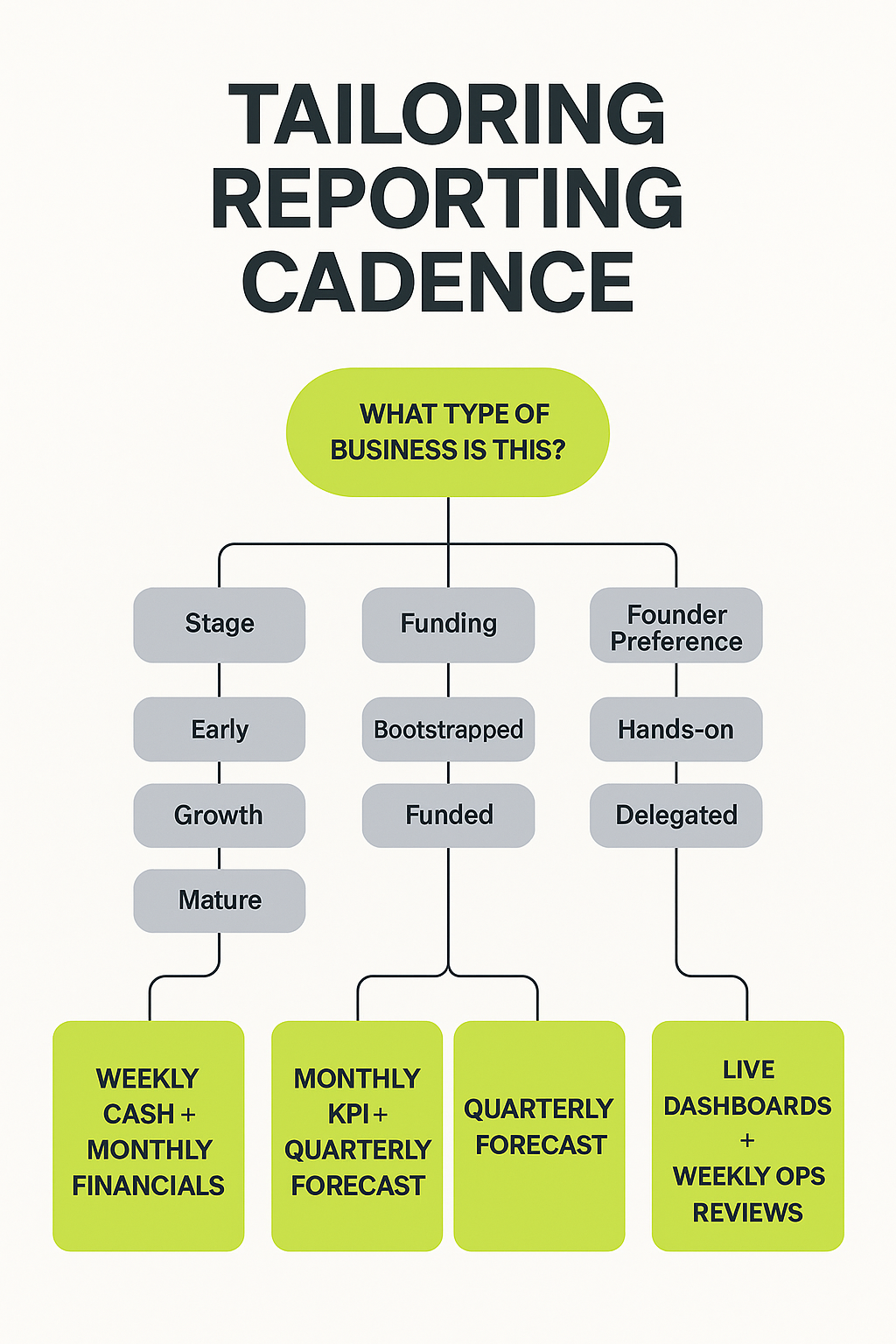
    There’s no one-size-fits-all approach. The right cadence depends on the business model, the funding setup, the team’s habits, and the type of decisions being made. In some cases, weekly reporting is essential. In others, a tighter monthly rhythm with real-time dashboards does the job.

    This is why we start every client relationship by understanding the real needs behind the numbers and we build the cadence from there.

    Because when finance reporting is built around context, stage, and decision-making rhythm, it becomes a growth lever not just a compliance task.

    What Is Reporting Cadence (and Why It’s Misunderstood)

    At its core, reporting cadence is the rhythm at which financial information is reviewed and used weekly, monthly, quarterly, annually. But cadence is more than just setting a calendar; it's about matching the speed of your business with the flow of insights.

    The mistake many businesses make is treating cadence as a box-ticking exercise:
    “Close the books monthly? Check.”
    “Quarterly forecast? Done.”

    But here’s the issue: if the cadence doesn’t match how fast decisions need to be made, then even accurate reports lose their value.

    For example, in a high-growth business, cash can move significantly in just a few days. Waiting for a month-end report might mean missing a risk or an opportunity. On the other hand, a mature, stable business might not need weekly forecasting, and doing so would just create noise.

    The right cadence bridges the gap between what’s happening in the business and when decision-makers need to know about it.

    Cadence Isn’t Copy-Paste: Every Business Has Its Own Rhythm

    There’s a common mistake many finance teams make: they use the same reporting cadence for every client or company. A standard monthly close, a quarterly forecast, maybe an annual board pack. Done.

    But reporting cadence shouldn’t be copied, it should be personalised to each business.

    A bootstrapped startup with five people and tight cashflow doesn’t need the same reports or frequency as a Series B-funded scaleup with multiple departments and an active board. Even if both businesses are in the same industry and making the same revenue.

    Founders also operate differently. Some want to see numbers weekly and use them to make quick decisions. Others prefer a higher-level monthly overview, with less operational detail.

    That’s why the best cadence is built by asking the right questions first:

    • What decisions are you trying to support?
    • How often do those decisions need to be made?
    • What level of detail is useful and what’s just noise?
    • What’s the funding situation?
    • What stage is the business in?

    The goal isn’t to prepare every possible report.
    It’s to deliver the right insight at the right time, without slowing the team down.

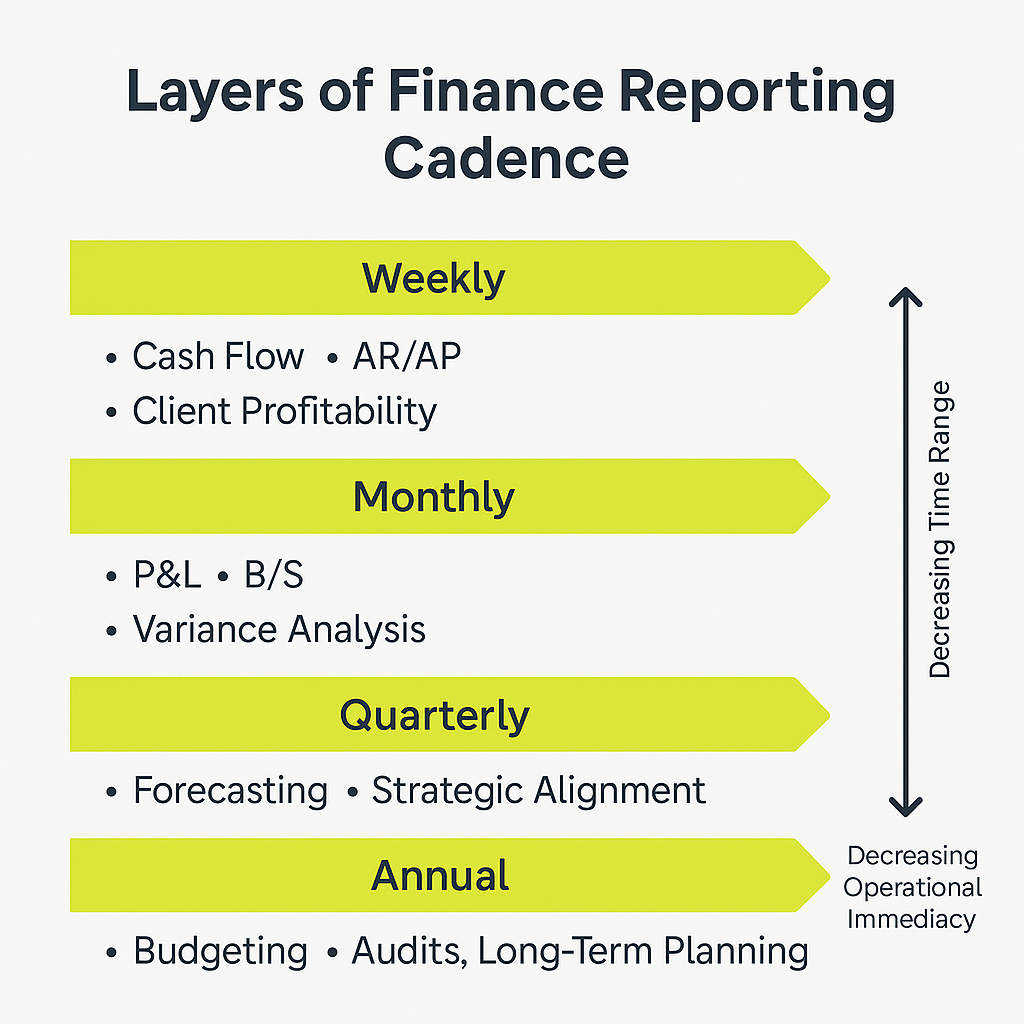
    The Core Layers of Reporting Cadence

    A good reporting system isn’t just about what gets produced, it's about when it gets produced, why it exists, and who it’s for.

    Each layer of reporting serves a different purpose:

    Weekly – Keep Your Finger on the Pulse

    Designed to help founders and leadership teams make quick, tactical decisions.

    Focus:

    • Cash flow visibility
    • AR/AP updates
    • Client-level profitability
    • Operational performance vs expectations

    Why it matters:
    You don’t want to realise at month-end that a key client became unprofitable, or that you're over-servicing without knowing it. Weekly cadence gives you the early warning system to course-correct before problems escalate.

    Monthly – Reflect, Analyse, Reforecast

    The most common cadence but only valuable when used to drive action.

    Focus:

    • Full financial statements (P&L, Balance Sheet, Cash Flow)
    • Variance analysis (Actual vs Budget, MoM, Year-on-Year)
    • Budget re forecasting if trends shift
    • Financial Strategy and adjustments if needed

    Why it matters:
    This is where teams can zoom out, evaluate strategy, and align on what’s working or not. But it only works if financials are accurate, timely, and paired with thoughtful commentary.

    Quarterly – Align Strategy & Stakeholders

    This layer is more strategic, often involving investors or board members.

    Focus:

    • Strategic re-forecasting
    • Business unit performance
    • Investor-ready packs
    • Progress vs goals or OKRs

    Why it matters:
    Quarterly reporting is the bridge between tactical action and long-term direction. It forces reflection, alignment, and higher-level decision-making.

    Annual – Plan, Budget, Comply

    Less about operations, more about structure and direction.

    Focus:

    • Budget planning
    • Audits & statutory filings
    • Strategic roadmap
    • Multi-year projections (when needed)

    Why it matters:
    Annual cadence creates the foundation for forward-looking control. It’s not about forecasting perfectly, it’s about aligning the business for the long game.

    When to Break the Rules: Adjusting Cadence in Fast-Moving Environments

    The reality is, even the best-designed reporting cadence needs to flex.
    In high-growth businesses, change happens fast and that can make long-term plans obsolete overnight.

    We’ve seen this many times for our clients: a 12-month budget built in Sept previous year becomes irrelevant by March. A startup lands a major client, raises funding, or shifts its pricing and suddenly the assumptions behind the entire plan no longer hold.

    In these moments, sticking rigidly to the “monthly report / quarterly forecast” cycle does more harm than good.

    What We Do Instead:

    When speed picks up, we shift the cadence:

    • Move from annual budget review to a rolling 3-month re-forecast
    • Increase weekly visibility (cash, client margin, operational delivery)
    • Focus on real-time indicators instead of lagging metrics

    The shift is simple: weekly becomes the decision-making layer, and monthly becomes the audit trail.

    For example, every Monday, we:

    • Update the 13-week cashflow
    • Refresh AR and AP
    • Review client servicing levels
    • Assess profitability per client
    • Re-forecast where needed
    • Sit with the management team for review

    This rhythm allows fast teams to act before the damage is done, not after.

    Don’t Confuse Activity with Impact

    It’s easy to default to more reports, faster cycles, tighter updates.
    But that can create noise.

    The point isn’t just to report faster, it’s to report at the speed decisions need to be made.

    The Most Overlooked Report: The Balance Sheet

    Ask most founders what they review regularly, and you’ll usually hear:
    Revenue
    Profit
    Cash position

    What rarely comes up?
    The Balance Sheet.

    And yet, this is often where the real risks are hiding.

    Why It Gets Ignored:

    • It’s misunderstood, many non-finance leaders don’t know how to read it
    • It feels less “operational” than the P&L
    • It doesn’t directly show performance, it shows position

    But here’s the thing: the Balance Sheet is where you track your company’s resilience.
    If the P&L is a sprint recap, the Balance Sheet is the health check after the race.

    What the Balance Sheet Really Tells You:

    • Are you accumulating uncollected receivables?
    • Are you under-capitalised relative to your liabilities?
    • Are your inventory levels starting to choke your cash?
    • Are you stretching vendors or relying on short-term debt to stay afloat?

    When reviewed properly, it gives early warnings you won’t see in a profit report.

    Making It Useful (Not Just a Compliance Document):

    • Track working capital trends over time
    • Build in Balance Sheet KPIs like current ratio, debtor days, and equity buffer
    • Tie movements to actual business events (e.g., delayed invoices, increased prepayments)
    • Visualise asset/liability shifts over time for clearer interpretation

    When founders understand and use the Balance Sheet unlocks better decisions and prevents nasty surprises.

    Dashboards vs Reports: You Need Both, But for Different Reasons

    In finance, the conversation often becomes binary:
    “Should we build a real-time dashboard or stick to structured reports?”

    The answer isn’t either/or.
    The best-performing businesses use both and for different purposes.

    Dashboards = Direction in Real Time

    Dashboards are living systems. They’re updated automatically (or frequently), and they answer one key question:
    “How are we doing right now?”

    Use dashboards to:

    • Monitor cash runway
    • Track revenue pacing or client delivery in-week
    • Surface immediate risks (e.g., over-servicing, margin squeeze)
    • Support quick, operational decisions

    They're ideal for fast-paced teams who need to course-correct on the fly.

    Reports = Meaning and Accountability

    Structured reports, on the other hand, allow for reflection and deeper analysis. They aren’t just about today they help you understand what happened and what to adjust moving forward.

    Use reports to:

    • Reconcile financial accuracy
    • Analyse budget vs actual
    • Explain trends and performance
    • Drive accountability in leadership meetings

    This is where monthly and quarterly cadences come into play.

    The Key Is Knowing When to Use What

    • Dashboards = motion
    • Reports = interpretation
    • Dashboards = speed
    • Reports = structure

    Used together, they give you both immediacy and insight—which is exactly what a finance function needs to support smart decisions.

    What Makes a Good Reporting Cadence? One That’s Designed, Not Duplicated.

    Many finance teams fall into the trap of standardisation, repeating the same reports for every client or business, regardless of size, funding, or priorities.

    But a strong reporting cadence isn't built around templates.
    It’s built around context.

    At Quantro, we don’t start with reports.
    We start with questions:

    • What’s the founder trying to achieve in the next 6–12 months?
    • What decisions are being made weekly, monthly, or quarterly?
    • Is this a bootstrapped business that watches cash daily, or a funded company focused on burn efficiency?
    • How involved is the leadership team in the day-to-day numbers?

    This discovery process helps us build a cadence that fits not one that overwhelms or under-delivers.

    Not Too Much, Not Too Little

    We’ve seen both extremes:

    • Clients flooded with dashboards they never open
    • Others flying blind with just a P&L and nothing more

    The sweet spot is a reporting rhythm that:
    – Matches business velocity
    – Respects the team’s bandwidth
    – Drives decisions
    – Reduces noise

    You don’t need 20 reports.
    You don’t need 1.
    You need the right few—delivered at the right time.

    Reporting Is Rhythm, Not Just Data

    A well-structured finance function isn’t just about accuracy, it’s about timing, relevance, and rhythm.

    When reporting cadence is thoughtfully designed, it stops being a back-office task and becomes a forward-looking tool. It helps businesses:

    • Spot risks before they escalate
    • Align decisions across teams
    • Understand both performance and position
    • Act with confidence, not assumptions

    But cadence isn’t something you set once and forget.
    It needs to adapt based on pace, stage, funding, and the personalities in the business.

    The goal isn’t more reporting.
    It’s better timing, sharper focus, and actionable insights.

    Whether it’s a live dashboard, a Monday cashflow review, or a quarterly investor update, the value lies in seeing the right numbers, at the right time, in the right context.

    That’s what makes finance useful. And that’s what makes cadence strategic. At Quantro, we can help make that strategic decision and recalibrate your reporting.

  • Cash Reserves: How Much Should Your Startup Really Hold?

    Cash Reserves: How Much Should Your Startup Really Hold?

    Determining how much cash reserves a startup should maintain is a critical aspect of financial management that can influence the long-term success and stability of the business. Cash reserves act as a financial buffer, providing the security to handle unexpected expenses, economic downturns, and growth opportunities. The global pandemic is a prime example of unexpected challenges necessitating cash reserves. Striking the right balance between maintaining sufficient reserves and investing back into the business is an ongoing challenge for many startup founders. This article explores various strategies and considerations for determining the appropriate amount of cash reserves for your startup, drawing on personal experiences and industry-specific insights.

    Financial planning must be both strategic and flexible. Factors such as industry-specific needs, the startup’s stage, and the overall economic climate significantly shape the approach to cash reserves. While conventional wisdom suggests maintaining three to six months’ operating expenses, many startups find their unique circumstances require more tailored strategies. Let’s dive into the guide to help startups navigate the complexities of cash reserve management.

    Understanding Cash Reserves

    Cash reserves refer to the funds a business keeps readily available to meet short-term and emergency needs.

    These financial resources provide a financial cushion, ensuring that the business can continue operations even in the face of unexpected challenges such as sudden drops in revenue, unexpected expenses, or economic downturns. Cash reserves are typically held in liquid forms, such as savings accounts or money market funds, which can be quickly accessed when needed. The benefit of having the idle cash into savings accounts or money market funds is that you get a return of around 5%. So, despite maintaining money to provide stability and security, allowing the business to navigate through difficult periods without the immediate need to secure additional funding, you can make some extra revenue and cash.

    For startups, having adequate cash reserves is particularly crucial. Unlike established businesses, startups often face higher levels of uncertainty and volatility. They might not have consistent revenue streams or long-standing credit lines to fall back on. With cash reserves, startups can weather short-term financial storms and avoid making hasty decisions under pressure, such as taking on high-interest debt or cutting critical expenses. The biggest problem when you require immediate cash from loans is the high interest you will pay on those debts.

    As those are close to emergency funds having 20% interest. If things are not going well, you will be lucky to get one from a bank. So, to avoid that, you should always be prepared for the worst and have credit facilities or loans before you need them. Additionally, cash reserves can provide the flexibility to seize unexpected opportunities, such as investing in new technology or expanding operations, which can drive long-term growth and success.

    Do you have enough cash?

    Managing cash flow in a startup always balances, ensuring financial security and making strategic investments for growth. Drawing from personal experience, it’s clear that determining the right amount of money to hold as cash reserves versus what to invest is influenced by numerous factors. For example, understanding your base revenue, confirmed revenue and fixed costs is crucial.

    In service-based businesses, dealing with clients and employees with specific notice periods adds another layer of complexity. As a rule of thumb, maintaining reserves equivalent to three times your monthly fixed expenses can provide a sufficient buffer.

    This approach proved effective during the tech bubble, offering enough time to recover from bad sales periods while keeping funds in high-interest liquidity accounts to avoid idle cash losing monetary value.

    Lessons Learned

    The importance of having an adequate cash reserve was underscored during the tech bubble when significant losses were incurred. This situation highlighted the necessity of proactive financial planning and the ability to foresee potential bumps on the road. Faced with $725k in losses over 15 months, it became evident that cash reserves were insufficient to cover both expected and unexpected costs, leading to the need for expensive short-term loans. To prevent such shortfalls in the future, we established a credit facility under favourable terms and developed alternative credit methods. This proactive approach ensures the business is better prepared for financial challenges, reinforcing the importance of maintaining robust cash reserves.

    Industry-Specific Factors

    Every industry demands different strategies for determining the right amount of cash reserves for a company. For instance, consider a manufacturing startup that relies heavily on raw materials and inventory management. Such a business must maintain a substantial cash reserve to cover the costs of purchasing materials in bulk, which can be subject to price volatility. Additionally, the manufacturing process often involves significant lead times, and any disruption in the supply chain can delay production and sales. Therefore, maintaining a cash reserve that covers several months of operating expenses can help the business manage these uncertainties and ensure smooth operations even when faced with supply chain disruptions or sudden increases in material costs.

    Additionally, whether a startup is funded or bootstrapped is crucial in determining its cash reserves. Funded startups may have more leeway in maintaining lower reserves due to their access to additional funding rounds, whereas bootstrapped startups might need to be more conservative.

    Moreover, the business stage—whether in the growth or scaling phase—also dictates the amount of cash reserves needed. Startups in the early growth phase might require larger reserves to navigate the unpredictability of market conditions and operational challenges. For example, a tech startup focusing on rapid product development and market entry will need substantial reserves to cover R&D costs, marketing expenses, and initial operational outlays.

    On the other hand, a startup in the scaling phase, with more predictable revenue streams and established customer bases, might manage with relatively smaller reserves but should still be prepared for any unexpected expenses or opportunities. Understanding these industry-specific nuances is essential for tailoring a cash reserve strategy that aligns with the company’s unique needs and risks.

    Balancing Cash Reserves with Investment Cash Flow

    Balancing the need for cash reserves with the potential opportunity cost of not investing those funds back into the business is a complex but crucial aspect of financial management. One effective approach to this balancing act involves evaluating potential investments based on their return on investment (ROI) and payback periods.

    For instance, if an investment promises a high ROI but has a slow payback period, it requires careful consideration to ensure it doesn’t jeopardise the company’s financial stability. Conversely, opportunities that offer a decent ROI with a quick payback period can be more appealing, especially if they don’t significantly impact liquidity. This method ensures that funds are preserved for emergencies and utilised effectively to drive business growth.

    In practice, having idle cash reserves might earn around 5% per annum, which is not just about the returns but also about the safety and liquidity it provides. Highly liquid investments, such as Fidelity Cash Reserves, are short-term investment options that provide quick access to financial resources without the need for a large amount of cash on hand. However, when the business experiences significant profits, making a quick investment that yields more than 5% in a short period can be a no-brainer. The key is to create detailed risk assessments, including good, bad, and average scenarios, and develop a plan for each.

    This involves modelling potential outcomes and ensuring that even in the worst-case scenario, the business can continue to operate smoothly. By balancing immediate cash needs and long-term investments, startups can ensure they are well-prepared for opportunities and challenges.

    Cash Reserve Adapting to the Current Economic Climate

    Given the current economic climate, the conventional wisdom of maintaining three to six months of operating expenses in cash reserves is generally sound. Reviewing financial statements to determine the appropriate amount to be placed in a cash reserve is crucial. Still, adjustments may be required based on specific circumstances. Startups must consider the overall economic environment, including inflation rates, interest rates, and market volatility. Because that might challenge their ability to raise money.

    In today’s context, where economic conditions can be unpredictable, a cash reserve covering at least three to six months of expenses can provide a necessary buffer. However, it might be wise to maintain a more substantial reserve for startups that can raise funds easily or are in a high-growth phase. Flexibility is key in adapting cash reserve strategies to the current economic landscape. For instance, if significant investment opportunities promise quick returns, startups might choose to reduce their cash reserves temporarily, provided they have contingency plans in place. Establishing credit facilities or maintaining relationships with investors can ensure that additional funds can be accessed quickly.

    Additionally, monitoring economic indicators and being prepared to adjust reserve levels accordingly can help startups effectively navigate uncertain times. By continuously reassessing their financial strategies and adapting to changing conditions, startups can balance maintaining financial security and pursuing growth opportunities.

    Closing Thoughts for Cash Reserve Amount

    Determining the right amount of cash reserves for your startup is a critical aspect of financial management that requires careful consideration of various factors. From understanding the basic purpose and importance of cash reserves to tailoring strategies based on industry-specific needs and economic conditions, maintaining adequate reserves is essential for navigating uncertainties and seizing growth opportunities. Reviewing financial statements for each accounting period helps determine the size of a cash reserve by analyzing the previous year's cash flow statement to calculate the monthly cash burn rate and leveraging the company's projected cash flow and budget. Balancing the safety of cash reserves with the potential returns from investments involves strategic planning and continuous reassessment to ensure your startup remains resilient and poised for success.

    Partnering with experts like quantro.gr can provide the guidance and resources needed to develop effective cash reserve strategies and capitalise on growth opportunities. With tailored financial plans, access to funding, and robust risk management frameworks, startups can confidently navigate the complexities of financial management. By maintaining a proactive approach and leveraging expert support, your startup can achieve financial stability and drive long-term growth.

    *Thumbnail image from September 3, 2025

  • Cash Flow Creativity: Strategies to Keep Your Money Moving

    Cash Flow Creativity: Strategies to Keep Your Money Moving

    The Vital Pulse of Business Health—Cash Flow Management

    Managing cash flow effectively is not just a financial task—it's a vital strategy that breathes life into every business, influencing everything from day-to-day operations to long-term planning and growth. Cash flow management involves monitoring, analysing, and optimising the cash entering and exiting your business. This dynamic process ensures that a company can meet its financial obligations, avoid excessive debt, fund itself, invest, and secure a prosperous future.

    Understanding and mastering cash flow is crucial because it affects every part of your business. Unlike profit, a theoretical figure reflecting earnings minus costs, a cash flow statement is the real-time lifeline of financial resources that helps a business stay operational and solvent. By implementing innovative cash flow management strategies, businesses can survive in competitive markets and position themselves for growth and success. We will explore foundational concepts and pioneering strategies that can transform standard cash flow practices into powerful tools for business enhancement.

    Innovative Cash Flow Management Strategies

    Strategy 1: Rethinking Payment Cycles

    One often overlooked aspect of cash flow management is the strategic use of payment cycles to optimise cash inflows and outflows. For instance, consider the potential of cashback credit cards. Businesses can earn significant returns over time by utilising these for operational expenditures. For example, if an advertising agency places its media buys through such a card, the 0.1% to 1.75% cashback on substantial annual spending can add to net income. This approach not only enhances liquidity but also turns ordinary expense transactions into opportunities for income generation.

    Moreover, negotiating favourable payment terms with suppliers can significantly impact cash flow. Proactive negotiations can extend payment deadlines, aligning outflows more closely with inflows from receivables. This strategy is crucial during growth or unexpected slowdowns, as it helps maintain a stable operating capital. 

    Businesses can implement structured payment runs to refine this process further. They schedule payments only after receiving customer payments, conserving net cash flow and reducing the need for further loans or external financing.

    Strategy 2: Creative Use of Financial Tools

    Another innovative approach involves the placement of idle funds into high-yield, next-day liquid savings accounts or dividend market funds. These tools can generate annual returns of up to 5%, turning stagnant cash reserves into productive assets. This technique is particularly valuable for businesses with large, fluctuating cash balances, providing them with a buffer of money that earns interest, the income from which can be crucial during leaner times. Furthermore, integrating these financial practices requires minimal adjustment to existing processes but offers substantial benefits, highlighting how traditional cash management can be enhanced through creative thinking and strategic financial planning.

    These strategies show that cash flow management can extend beyond mere number-crunching into strategic financial engineering, where every decision can influence the company's financial health, operational efficacy and net cash flow.

    Technological Tools for Cash Flow Optimisation

    Advanced technological tools are pivotal in optimising cash flow management. Embracing technology simplifies a business's financial operations and provides real-time data that can be crucial for making informed decisions. For instance, integrating automated Google Sheets with accounting software allows businesses to view their financial status live. This setup automates the data entry process and updates cash flow forecasts dynamically based on daily transactions, ensuring that business owners can see the financial implications of their day-to-day decisions instantly.

    We often use services for that with our clients and set up alerts to be sent automatically to their Slack if cash flow or revenue drops from a certain threshold.

    Specialised tools like Agicap, Float, Fathom, and Casual enhance cash flow management. These software solutions offer tailored functionalities for tracking and forecasting cash flow, enabling businesses to anticipate future cash flow requirements and plan accordingly and accurately. Such tools often include features allowing scenario planning, which can be invaluable in preparing for various financial futures. By employing these technological aids, businesses can move beyond static spreadsheets and engage in active, strategic financial management that aligns with their growth objectives and operational needs.

    The only drawback of using those tools is usually that you need some financial expertise to use them and keep them updated; none of the tools are accurate enough on autopilot. 

    The key benefit of utilising these technological tools lies in their ability to free up business owners and financial managers from the time-consuming tasks of manual cash tracking and forecasting. This efficiency reduces the risk of human error and allows leaders to focus more on strategic decision-making rather than day-to-day financial administration. 

    Proactive Cash Flow Forecasting

    Proactive cash flow forecasting is essential to strategic financial management, enabling businesses to anticipate future cash requirements and navigate financial challenges effectively. Forecasting acts as a financial radar, helping businesses foresee periods of cash surplus and shortfall and facilitating more informed decision-making regarding investments, expenses, and debt management. By regularly updating poor cash flow forecasts based on current business activity and market conditions, companies can maintain a clear vision of their financial trajectory and adjust their strategies proactively.

    By being proactive, we often moved the needle early to get as much cash for our clients as possible to avoid cash flow crunches and jeopardise their growth.

    Implementing advanced forecasting involves more than just predicting future or negative cash flow flows; it requires a deep understanding of the business cycle, seasonal trends, and potential market disruptions. Tools like scenario planning are particularly useful in this context. They allow businesses to test different financial outcomes based on varying conditions, such as an economic downturn or a sudden spike in product demand. This planning allows businesses to pivot their operational strategies swiftly and confidently, ensuring financial stability and continued growth.

    We always use the Best, Good, Break-even and Worst scenarios for our clients. Using technology, you can instantly choose which scenario you want to see and the outcome that provides.

    In addition to technical tools, cultivating a mindset within the organisation prioritising forward-looking financial planning is crucial. Engaging multiple departments in the forecasting process can provide diverse insights and data, enhancing the accuracy of forecasts. This collaborative approach improves the quality of financial projections and fosters a culture of financial awareness and preparedness across the company. 

    Negotiating Better Deals

    Effective negotiation with suppliers and creditors is a pivotal strategy for managing cash outflows and improving overall cash flow. Regular negotiation can secure better payment terms, extend due dates or reduce prices, and significantly ease cash flow pressures. For example, by agreeing to make payments on a bi-monthly basis aligned with receivables, businesses can ensure they have the necessary stock of cash on hand to meet obligations without resorting to costly short-term financing.

    The art of negotiation goes beyond simply asking for better rates or more time to pay; it involves building strong relationships with suppliers that can lead to mutual benefits. This can include sharing forecasts and production plans with suppliers to assist them with their own planning, which might, in turn, incentivize them to offer discounts or more favourable terms. A strategic approach to negotiations—one seen as fair and beneficial to all parties—can result in deals supporting sustained financial health and operational efficiency.

    A lot of CFOs' time is spent on building relationships with different stakeholders. From suppliers to financing creditors and preparing the business for any unexpected turn. We at Quantro have built and used those relationships for our clients across our portfolio. 

    Building a Cash-Savvy Organisational Culture

    Cultivating a more positive cash flow-savvy organisational culture is a strategic endeavour that can significantly enhance a business's overall financial health. This involves investing in education and engagement of every tier in the organisation about the principles of cash flow management and its critical role in the company's success. By fostering financial literacy among all employees, businesses can develop a workforce that is proactive about managing costs and optimising cash use, which is fundamental to sustaining operational agility.

    To build this kind of culture, companies can start by providing regular training sessions that cover basic financial concepts and the specific cash flow practices relevant to their roles. In addition, integrating financial metrics into performance reviews can incentivise employees to adopt more cashflow-conserving behaviours. Such practices deepen understanding of cash flow forecast and align everyone's efforts towards the company's financial goals, creating a collective responsibility for financial stability. These efforts should be supported by transparent communication about the company's financial status and goals, which can help to align all staff with the business's strategic vision.

    By embedding these principles deeply into the company ethos, businesses can ensure that their teams are not only aware of the importance of cash flow but are also equipped to make decisions that contribute positively to it. This unified approach improves financial outcomes and strengthens the company's resilience against economic fluctuations, positioning it well for future growth and success. 

    Harnessing the Power of Proactive Cash Flow Management

    Effective cash flow management is not just a financial necessity—it's a strategic advantage that can define and determine the success of a business. By implementing the strategies discussed—from innovative financial tactics to investing and leveraging technology to fostering a cash-savvy culture—companies can transform their cash management from a passive ledger activity into a dynamic asset that drives business growth. These methods ensure businesses survive and thrive by making informed, strategic decisions that enhance their financial stability and operational efficiency.

    To truly benefit from these strategies, businesses must integrate them into all operations. This integration involves adopting new tools and practices, shifting the organisational mindset to value cash balance more, and understanding financial management as a core business function. Such a holistic approach to finance can mitigate risks associated with cash flow fluctuations and equip businesses to capitalise on opportunities swiftly and effectively.

    In conclusion, as markets continue to evolve and financial pressures mount, the ability to manage cash flow creatively and proactively is more critical than ever. Businesses that embrace these sophisticated cash flow management techniques will make more money and be better positioned to navigate the complexities of modern economies, ensuring longevity and success in the competitive business landscape. Remember, cash flow management is the heartbeat of your business, and keeping it healthy requires constant attention, innovation, and commitment.

    *Thumbnail image from September 3, 2025

  • Can One Finance Leader Do It All? CFO vs. Controller, what your business needs?

    Can One Finance Leader Do It All? CFO vs. Controller, what your business needs?

    Finance roles are often misunderstood—especially in growing businesses. It’s common for founders to blur the lines between a Controller and a Chief Financial Officer (CFO), assuming they’re just different labels for the same function. But this misconception can quietly hold a business back. While both roles are essential to financial health, they serve very different purposes, require distinct mindsets, and most importantly—drive very different outcomes.

    Getting this right isn’t about semantics—it’s about strategy. Hiring a Controller when you really need a CFO means optimising for control instead of growth. And the reverse—expecting a CFO to manage day-to-day accounting—wastes resources and dilutes impact. Let’s unpack the real differences between these two critical roles, when you need each, and how hiring the right person at the right time can transform your business from financially functional to financially powerful.

    Understanding the Role of a Controller

    A Controller is the backbone of your internal finance function. Their role is primarily operational—focused on maintaining accurate financial records, ensuring compliance, managing reporting, and enforcing internal controls. They make sure the numbers are clean, the processes are tight, and the business stays on track with regulatory requirements. In short, they keep the house in order.

    Controllers are detail-oriented doers. They’re fluent in accounting standards, comfortable with spreadsheets and ERP systems, and excellent at spotting discrepancies before they become problems. Their priority is accuracy and discipline, not commercial strategy. If your business needs someone to run payroll, close the books, manage invoices, and prepare monthly reports, a Controller is the right fit. But if you’re expecting them to guide high-level decisions or lead your growth plan—you’re likely expecting too much from the wrong role.

    Understanding the Role of a CFO

    A Chief Financial Officer (CFO) operates on an entirely different level. Their role is not about looking backwards—it’s about looking ahead. A CFO provides strategic financial leadership, helping the business make informed, data-backed decisions that support sustainable growth and long-term value creation. While they understand the numbers, their real power lies in knowing what to do with them.

    A strong CFO—whether full-time or fractional—will focus on forecasting, scenario planning, investment strategy, and working capital optimisation. They work hand-in-hand with leadership teams across the business, aligning financial strategy with commercial objectives. From marketing campaigns to sales hires, from funding rounds to CAPEX planning, the CFO plays a key role in prioritising what will drive the highest return with the lowest risk. They don’t just manage costs—they help the business scale with confidence.

    Why Mindset Matters: The Growth Enabler (CFO) vs. the Gatekeeper (FC)

    The biggest difference between a Controller and a CFO isn’t just what they do—it’s how they think. A Controller’s mindset is rooted in protection: safeguarding the business through accuracy, compliance, and cost control. They’re there to maintain order, keep things tidy, and ensure nothing slips through the cracks. That’s incredibly valuable—but when it becomes the dominant voice in a growing business, it can unintentionally hold the company back.

    A CFO’s mindset is geared towards growth. Their default is not “How do we cut costs?” but “Where should we invest for the best return?” They embrace calculated risk, advocate for strategic spending, and help leadership prioritise initiatives that will drive real commercial impact. Where a Controller might be inclined to say “no” to preserve the budget, a CFO asks “how” to make the numbers work for the opportunity ahead. That shift in perspective—from guarding the business to growing it—is what separates operational finance from strategic finance.

    The Ideal Timeline: When to Hire Each One

    The timing of when to bring in a Controller versus a CFO can make a significant difference in how efficiently—and how confidently—your business scales. It’s not just about the size of your business, but about its complexity and ambition.

    As soon as your business starts to gain traction, you’ll need someone who can keep your financial house in order. This is when a Controller or strong finance manager should come in. They’ll ensure that bookkeeping is clean, data is timely, and reporting is accurate—because without a solid foundation, even the best strategy will fall apart. And no, outsourcing bookkeeping to an accountancy practice isn’t enough. Bookkeeping isn’t just about compliance—it’s about building trust in your numbers so you can use them to make informed decisions.

    Once you pass the €1M revenue mark and you have serious growth aspirations, that’s when you should consider bringing in a fractional CFO. Even on a part-time basis, a CFO can instantly add strategic value, helping you with financial planning, capital allocation, working capital optimisation, and guiding big-picture decisions. It’s one of the smartest investments a scaling business can make—long before you’re ready to hire a full-time CFO.

    Can One Person Do Both Jobs?

    In theory, yes. In practice? Rarely—at least not effectively. While it might seem efficient to hire one person to handle both the financial operations and strategic planning, the reality is that Controller and CFO roles demand completely different skill sets and mindsets. Expecting one person to excel at both can result in one of two outcomes: overstretching a strategic leader with administrative tasks, or relying on an operational manager for high-level financial decisions they’re not equipped to make.

    For early-stage businesses, a more sustainable (and cost-effective) structure is to have an in-house Controller managing the day-to-day finance function, while engaging a fractional CFO to lead on strategy. The Controller ensures data integrity, process discipline, and compliance. The fractional CFO brings experience, commercial insight, and future-facing leadership. Together, they form a finance function that is both solid at the core and sharp at the edge—able to maintain control while pursuing growth.

    Real-World Impact: What Happens When You Get It Right (or Wrong)

    Hiring the wrong financial role for your stage of growth can quietly stall your progress. One common mistake? Hiring a Controller and expecting them to act like a CFO. What often happens next is predictable: strategic decisions are delayed, growth opportunities are missed, and the business becomes focused on maintaining the status quo instead of pushing forward. The result? A financially compliant company that’s structurally sound—but strategically stuck.

    On the flip side, when you get the mix right, the results are transformative. We’ve seen it first-hand at Quantro. In one case, a business with no financial visibility was making decisions purely on gut. Once we implemented a live dashboard with dynamic KPIs and paired it with strategic guidance, they saw 297% revenue growth, a 200%+ profit increase, and doubled their cash on hand—all within 18 months. That growth didn’t come from cutting costs. It came from using finance to unlock smarter, faster decisions.

    Two Roles, One Goal – Smarter Growth

    A Controller and a CFO serve very different purposes—but together, they provide the foundation and fuel for sustainable growth. The Controller ensures the business is built on accurate, timely financial data and solid internal processes. The CFO takes that foundation and uses it to drive the business forward—allocating capital strategically, guiding decision-making, and positioning the company for scale.

    Understanding the difference isn’t just helpful—it’s essential. Hire a Controller when you need control. Hire a CFO when you want growth. Get both in place at the right time, and you turn finance from a support function into a strategic advantage. At GrowthCFO, we help businesses build that kind of financial leadership—fit for scale, built for results.

    💬 Want to explore which one your business needs right now? Book a call with us today.

  • Beyond the Monthly Budget: The Strategic Edge of 13-Week Cash Flow

    Beyond the Monthly Budget: The Strategic Edge of 13-Week Cash Flow

    Cash flow forecasting isn’t just a financial hygiene habit — it’s a strategic tool.

    Many founders believe that so long as the monthly budget balances, they’re on solid footing. But business doesn’t move monthly — it moves weekly (even daily in some very fast pace industries). Suppliers get nervous on Tuesday, not at month-end. A cash shortfall on week 9 won’t show up on your P&L until it’s too late.

    This is why we build and maintain a 13-week rolling cash flow plan with every Quantro client — regardless of whether they’re flush with funding or tightening belts. It gives us time to see the issues coming, space to act, and the confidence to grab opportunities that short-term cash control makes possible.

    Whether you're running a real estate development cycle, a SaaS startup burning investor cash, or a scaling agency juggling payroll and pipeline, a 13-week view gives you clarity today — not regret tomorrow.

    What Is a 13-Week Cash Flow Forecast?

    At its core, a 13-week cash flow forecast is a short-term, rolling view of your expected cash inflows and outflows, updated weekly. Rather than thinking in months or quarters, this tool lets you plan your business’s financial reality on a week-by-week basis for the next 3 months.

    You’re not just looking at profit or loss (which doesn’t include VAT element init). You’re looking at actual cash movement: when invoices are expected to land, when suppliers will demand payment, when VAT is due, when salaries hit the bank. It’s granular. It’s live. And it’s actionable.

    Unlike static monthly budgets, the 13-week model forces founders to connect daily decisions with immediate cash impact. It’s not about forecasting perfectly — it’s about being directionally correct and having time to act. Each week, you roll it forward one week, incorporating the latest receivables, payables, and any adjustments in timing.

    It becomes your cash radar — and in business, visibility is everything.

    Why It’s Not Just for Cash-Strapped Companies

    There’s a myth that cash flow forecasting is only useful when things go wrong. In reality, a 13-week forecast is equally powerful when things are going right.

    For funded companies — especially in SaaS or product-based startups — the 13-week view gives clarity on burn rate and runway. It answers key questions like: Can we afford to hire next month? When do we need the next funding round? Are we spending ahead of plan? It brings discipline without limiting ambition.

    For fast-growing companies, this level of visibility enables better strategic timing. Let’s say you want to invest in new inventory, equipment, or marketing — the weekly forecast tells you when you’ll have the cash, or whether you can restructure payments to make it work. And for businesses that are cash-rich? That’s when timing matters most — using excess liquidity to negotiate better supplier terms, prepay obligations, or even capitalise on competitor weakness.

    Even distressed businesses benefit: if you’re facing tight cash, the 13-week model buys time and shows you your levers— whether it’s delaying a non-critical expense, accelerating collections, or securing a short-term facility before the squeeze becomes existential.

    In short, every business has something to gain from knowing what the next 90 days look like — not just where the year is going.

    Real Outcomes from Clients Who Use It

    At Quantro, we’ve seen first-hand how a 13-week cash flow plan turns uncertainty into opportunity. Here are two real cases from our own clients:

    🟢 Case 1: Securing funding before the storm hit

    One of our clients was showing strong revenue, but our 13-week forecast spotted a looming cash gap — still eight weeks away. Because we saw it early, we were able to prepare financials, speak to lenders, and secure a loan before the situation became urgent.
    The result? The client got better terms, faster approval, and avoided the classic last-minute financing panic that often leads to higher costs or missed opportunities.

    🟢 Case 2: Using surplus cash to negotiate better terms

    In another case, a client had a healthier-than-expected cash position. Most businesses would sit on that buffer. But because we had full visibility through the 13-week model, we analysed the opportunity cost of idle cash and realised we could negotiate early payment discounts.
    We approached a key supplier and secured a 7% discount by paying in advance — a decision that wouldn’t have been made without that week-level confidence in available cash.

    These aren’t dramatic turnaround stories. They’re strategic wins — and that’s the point. Cash flow visibility isn't just about survival. It's about timing, leverage, and control.

    What We Track Weekly and How We Automate It

    The power of a 13-week forecast comes from its rhythm — but the effectiveness lies in what you track and how reliably you update it.

    At Quantro, we build every 13-week cash flow model starting with a detailed budget. That gives us the “ideal case.” From there, we track and adjust weekly based on actual activity, not assumptions. Here’s what we focus on every single week:

    ✅ Accounts Receivable

    We break AR down into four buckets:

    • 0–30 days overdue
    • 31–60
    • 61–90
    • Over 90 days

    Each one has its own strategy. Recent invoices might just need reminders. Older ones might require escalation or factoring. Crucially, if key receivables don’t land, we don’t make corresponding payments — simple but powerful logic that keeps control centralised.

    ✅ Accounts Payable

    We track weekly obligations and match them to realistic inflows. No auto-payments unless cash is available. This weekly discipline prevents cascading issues like overdrafts or missed salaries.

    ✅ Tax, VAT, and Payroll

    We include all non-negotiables — VAT filings, tax prepayments, salary cycles. These are often forgotten until it’s too late, but in our model they’re always visible.

    ✅ Automation & Structure

    Once the budget is in place, we automate the full structure:

    • Weekly cash flow rolls forward
    • VAT and tax dates are auto-calculated
    • All changes link back to expected budget vs actuals
      This creates a system that doesn’t rely on memory, guesswork, or heroic spreadsheet manipulation every Sunday night.
    • On top of that we build hypotheses, where you can add costs or revenue and that will be illustrated automatically in both the budget and the cash flow.

    We built this for our clients at Quantro so they never ask “how much cash do we have left?” — they already know, and more importantly, they know when they’ll need more.

    What Founders Struggle With (and How to Overcome It)

    Most founders don’t resist cash flow forecasting because they think it’s a bad idea — they resist it because they’ve experienced it as a manual, clunky process that’s always out of date.

    Here are the most common challenges we see:

    ❌ “It’s too manual – I don’t have time to update it.”

    Without structure, weekly forecasting turns into spreadsheet chaos. People rely on static files, copy-paste errors, and best guesses. That’s why we always start from a budget — not a blank page — and build automation on top.

    ❌ “I don’t know what’s real and what’s hope.”

    Founders often mix up confirmed cash inflows with expected ones. That’s why we track AR in aged buckets and only count cash we’re confident in. You need to know the difference between “booked revenue” and “actual cash next Tuesday.”

    ❌ “I can’t see the connection to decisions.”

    Even when founders have a cash forecast, they don’t link it to strategy. Should you hire? Buy inventory? Delay a payment? Cash flow tools must inform decision-making, not just compliance reporting.

    The fix isn’t more accounting — it’s smarter financial design.
    When done right, a 13-week forecast runs in the background, alerts you before trouble, and empowers you before action.

    Conclusion

    In business, cash doesn’t move monthly — it moves weekly. And yet too many founders fly blind with outdated, static views of their finances. A 13-week cash flow forecast isn’t just a defensive tool for distressed companies — it’s a strategic system for every business, at any stage.

    Whether you're managing a burn rate, expanding into new projects, or negotiating supplier terms, clarity over the next 90 days empowers better decisions today. It protects you from the downside and positions you to seize upside. It replaces panic with planning.

    At Quantro, we believe every founder should know exactly when they’ll run out of cash — and exactly what to do before they get there. Weekly forecasting doesn’t just show you what’s coming. It gives you time to do something about it. Want to implement a 13-week cash forecast for your business? Let’s build it together.

  • Startups Odyssey: From Seed to Success

    Startups Odyssey: From Seed to Success

    The Startup Journey from Start to Growth

    Starting a business is a big adventure. It begins with a small idea – a seed – and grows over time through different stages. Each stage of a startup's growth is important and comes with its own challenges, especially regarding money. From the very beginning (Seed stage) to later stages (like Series C), businesses need to be smart about how they use their money to grow bigger and stronger. This isn't just about getting enough money to keep going; it's about making the right choices that will help the business succeed in the long run.

    Knowing how to handle your business's finances is super important. It's not just about keeping track of what you spend and earn; it's also about telling a story that investors will believe in, finding the best ways to make your product or service popular, and making smart choices that help your business grow in the right direction. This guide is here to help companies understand how to face money challenges at each step of their growth. We'll share tips and tricks on how to manage money from the very start all the way to later stages of growth.

    The Seed Stage – Laying the Foundations

    At the start of any business, the Seed stage is where all begin. This stage is all about turning your big idea into something real that can attract more support. You need to validate your idea in the market, create your MVP, test it and find if there is a product-market fit. But in order to achieve all that, you need some resources to get going. For businesses, this means money to develop your product, do research, and find the right people to join your team.

    Getting money at this stage has changed a lot. Nowadays, even the first bit of money you get can be quite big, more like what businesses used to get a decade ago when they were a bit more grown-up. This big start can be great, but it also means you have to be really careful about how you use it. You need to make sure you're spending on things that really help your business grow and not just burning money.

    You need to figure out where to spend your first bits of money so you can develop your product and get people excited about it without wasting huge resources. This careful planning in the Seed stage sets the foundation for everything that comes next, making sure your business is ready to grow strong and healthy, but also to successfully land its Series A, where many businesses have failed to do so. 

    The Leap from Seed to Series A: Mastering the Transition

    The transition from Seed to Series A is a pivotal moment in a startup's life cycle, marking a shift from proving a concept to proving the business can scale. This stage is less about the initial excitement of launching and more about demonstrating substantial progress and potential for significant growth. Achieving Series A funding signifies that a startup has successfully navigated the initial challenges of market entry and is now ready to scale its operations, product development, and market reach.

    To stand out and secure Series A investment, startups must present a compelling case to investors that goes beyond the innovative idea or product. This involves showcasing a proven product-market fit, a scalable business model, and a clear strategy for revenue generation. A strong focus on key performance indicators (KPIs), such as customer acquisition costs (CAC), lifetime value (LTV) of a customer, and monthly recurring revenue (MRR), is crucial. These metrics not only demonstrate the startup's current success but also forecast its future growth potential.

    Incorporating a financial expert or a fractional CFO at this stage can be a game-changer for startups. These professionals can provide strategic financial guidance, help in fine-tuning the business model, and prepare the startup for the rigorous due diligence process of Series A funding. They play a critical role in building a financial roadmap that outlines how the startup plans to achieve its growth objectives, manage cash flow efficiently, and optimise operational costs for scaling.

    Successfully navigating the Seed to Series A transition requires a delicate balance between rapid growth and the development of a sustainable, scalable business model. Startups need to be agile, continuously adapting their strategies based on market feedback while maintaining a clear focus on long-term goals. This strategic approach not only positions startups favorably for Series A funding but also lays a solid foundation for future growth stages.

    Scaling Up: Navigating the Series A to Series B Journey

    The journey from Series A to Series B is marked by the need to scale operations, refine the product, and expand market presence. This phase is critical for startups, as it requires not just growth but sustainable and efficient growth. The focus shifts from simply proving a concept to demonstrating the ability to execute on a larger scale, attracting further investment for expansion.

    For startups aiming to secure Series B funding, the emphasis is on showing strong customer traction, an expanding user base, and the scalability of the business model. Investors at this stage are looking for evidence that the startup can not only attract customers but also retain them over time, thereby increasing the lifetime value (LTV) and reducing the customer acquisition cost (CAC) in a way that promises long-term profitability.

    Operational efficiency becomes paramount. Startups must optimise their operations to support growth without compromising quality or customer satisfaction. This might involve investing in technology, hiring talent, and refining internal processes to improve efficiency and productivity. The goal is to build a robust operational framework supporting accelerated growth and expansion into new markets or segments.

    Financial metrics and modeling take center stage. At this point, startups must have clear visibility into their financial health and trajectory. This includes having a solid grasp of key financial metrics such as burn rate, gross margin, unit of economics and EBITDA. A comprehensive financial model that projects future growth and scalability is essential to convince investors of the startup's potential for success at the Series B stage and beyond.

    Navigating the transition from Series A to Series B requires a strategic approach focused on growth, efficiency, and financial acumen. By demonstrating a scalable business model, operational excellence, and a clear path to profitability, startups can successfully secure Series B funding and position themselves for the next phase of growth.

    Navigating Series B to Series C – Scaling for International Growth and Operational Excellence

    As startups transition from Series B to Series C funding, the focus intensifies on scaling operations for international growth and achieving operational excellence. This stage is about leveraging the foundation built in earlier phases to expand aggressively into new markets and refine business operations for peak efficiency.

    The move towards international growth requires a strategic approach, considering cultural nuances, regulatory environments, and market-specific consumer behaviours. Startups must conduct thorough market research to identify the most promising regions for expansion and tailor their product offerings and marketing strategies to meet local needs. This step not only broadens the customer base but also diversifies revenue streams, making the business more resilient to regional economic fluctuations.

    Operational excellence becomes paramount as startups scale. This involves streamlining processes, implementing best practices in every department, and adopting advanced technologies to enhance productivity and reduce costs. Efficient operations support rapid scaling by ensuring that growth does not compromise product quality or customer satisfaction. Furthermore, a focus on operational excellence helps startups optimise their cash flow and extend their runway, making them more attractive to investors looking for businesses with tight control over their finances.

    At the Series C stage, startups are expected to present solid financial metrics that indicate a clear path to profitability, if not profitability itself. This includes demonstrating strong unit economics, a sustainable growth rate, and effective management of operating expenses. Investors at this stage are particularly interested in seeing how startups plan to use additional funds to fuel growth without eroding profitability.

    The journey from Series B to Series C is characterised by the startup's ability to execute expansion plans while maintaining a tight grip on operational efficiency and financial health. Success in this phase is marked by a startup's ability to operate at a global scale, demonstrating that its business model can thrive across diverse markets and withstand the challenges of scaling operations internationally.

    Mastering Series C and Beyond: Preparing for Maturity and Market Leadership

    At the Series C stage, startups are on the brink of major expansion or even preparing for public offering. This phase is about leveraging existing successes to secure a dominant market position and ensure financial sustainability. The focus shifts towards strategic planning fro growth, operational efficiency, and exploring paths like IPOs or acquisitions.

    Success now depends on outmaneuvering competitors and solidifying the company's market presence. This could mean expanding product lines, entering new markets, or acquiring complementary businesses. The goal is to enhance the brand and deepen customer loyalty.

    Financially, companies must show profitability, strong cash flow, and efficient use of capital. Preparing for an IPO or attracting acquisition offers required rigorous financial discipline and transparency. Startups must balance growth with financial health to attract further investment or prepare for public markets.

    Wrapping Up the Startup Journey

    The journey from seed to Series C is a pivotal path for startups, marked by growth, challenges, and strategic milestones. Initially, securing seed funding is all about validating the business idea and beginning to carve out a market presence. As startups evolve to the Series A and B stages, the focus shifts to proving the business model, scaling operations, and refining the product-market fit. By the time they reach Series C, startups are preparing for significant expansion, operational scaling, or exploring exit strategies.

    Throughout this financial roadmap, the constant theme is the need for startups to adapt, strategise, and manage their finances smartly. Success lies in balancing innovation with strategic financial planning, ensuring the startup not only grows but thrives.

    Quantro is ready to support you in any stage your business is at and guide you on specific challenges you might have.

    *Thumbnail image from June 11, 2025