Author: Yiannis Papadopoulos

  • If AI Made You Faster, Why Are Your Margins Worse?

    The Speed Felt Like Progress. The Margin Did Not Move.

    Most services founders spent the last twelve months folding AI into delivery. Tasks that used to take days now take hours. Decks come back faster. Reports get drafted before the meeting ends. The team feels less stretched, the client feels well-served, and on the surface the business looks healthier than it has in a long time. So the founder closes the quarter expecting the P&L to confirm the story.

    It does not. Revenue is up, sometimes meaningfully. But gross margin has not moved, or has moved the wrong way. The leadership team puts it down to a few one-off cost lines, a slow month on a key account, a hiring decision that will normalise. The speed felt like progress. The margin says it was something else.

    The Tools Now Cost What Two People Used to Cost.

    The structural reason is simple, and most founders have not yet stopped to add it up. The AI stack sitting inside a typical services business has grown, quietly, to the price point of two to three full-time employees per month. A core language model subscription at the team level. A separate research tool. A writing tool. A design tool. A meeting transcription tool. A workflow automation layer. Each one looks small in isolation. Together they sit on the cost line where two mid-level salaries used to sit.

    This is not, on its own, a problem. The problem is what it has done to the shape of the cost base. Junior salaries flex with utilisation. A quiet month means fewer hours billed and fewer hours paid for. Software licences do not flex. They sit at full cost whether the team is at capacity or at half capacity. The cost of delivery has not collapsed. It has been rearranged, from a variable line that moved with the work into a fixed line that does not. Output is faster. The cost base is less forgiving.

    We Worked With An Agency That Was Doing More Work Than Ever.

    We worked with a mid-sized agency that had spent the previous year pushing AI deep into delivery. Turnaround times on client work had nearly halved. The team was producing more output per week than at any point in the agency’s history. Headline revenue was up. The founder believed the business had crossed into a different operating gear and that the next set of numbers would confirm it.

    The numbers did not. Gross margin had drifted down by a few points. The combined software and AI tool spend had grown to sit close to the cost of three full-time employees. Two junior roles that would normally have been filled had been quietly left open, because the team was managing without them. Senior time on each project had crept up rather than down, because someone still had to check, judge, and stand behind the work that AI had drafted. The agency was doing more work than ever. It was making less money per unit of work than it had a year earlier.

    AI Cut The Wrong Layer Of The Team.

    This is the part of the AI story that almost nobody is naming out loud. AI does not displace work evenly across a services team. It displaces the cheapest layer first. The junior researcher, the junior analyst, the junior copywriter, the junior designer. These are the roles that AI is genuinely good at substituting, because the work is structured, repeatable, and reviewable. So the team stops hiring at that level, or quietly lets the layer thin out through attrition. On paper, that looks like efficiency.

    What it does in practice is invert the cost pyramid. The senior layer is now responsible for everything AI cannot yet do well: judgement, review, client ownership, quality control, the parts of the work where being wrong is expensive. Senior hours per project go up rather than down. And the senior layer is the most expensive labour in the business. Most services firms have not been built for this shape. They were designed around a pyramid of junior execution feeding into a smaller senior layer of judgement. AI has flattened the bottom of that pyramid without rebuilding the top. The cheap labour is gone. The expensive labour is stretched. There is very little structural capacity in the middle, where most of the work used to be absorbed.

    But We Cannot Compete Without It.

    The most common founder response, when this is laid out on the table, is that there is no choice. AI is now the price of entry. A services business that does not use it cannot match the turnaround times, the price points, or the volume expectations of the market. This is true. Conceding it is important, because the argument that follows only works if the founder is not being asked to retreat from AI. They are not. They are being asked to look at who they are actually competing against.

    The competitive set has changed. The relevant competitor is no longer a similarly structured agency carrying the same OPEX base, running the same software, paying the same office and management costs. The relevant competitor is increasingly an AI-first business, built from scratch around a leaner cost base, with a smaller senior team, no junior bench to maintain, and an operating model that was designed around the tools rather than retrofitted to them. A legacy services business cannot match the margins of that competitor by bolting AI onto its existing cost structure. The bar has moved underneath the business, and the structure has not moved with it.

    AI Is A Relationship You Cannot Easily Leave.

    The other thing almost nobody is pricing in is what happens to the tool cost from here. AI platforms are currently in their growth phase. Pricing is subsidised, free tiers are generous, enterprise terms are flexible, and the cost per seat is artificially low while the platforms compete for share. This will not last. Most of the major AI platforms are heading into their profit-making phase, and the historical pattern in software is unambiguous. Prices go up. Free tiers narrow. Per-seat costs rise. Usage-based pricing models replace flat ones.

    The trap is that AI adoption, once it is wired into delivery, is very difficult to reverse. A services business that has redesigned its workflow around a particular set of tools cannot quietly unhook itself when the renewal quote arrives with a forty percent increase. The team has built habits, the clients have built expectations, the turnaround times have been quoted. AI has moved from a discretionary cost into a structural one, and structural costs are the hardest to negotiate down. A business that adopted AI without a plan is now locked into a cost line that will not stay where it is.

    Two Lines On The P&L That Tell You The Truth.

    There are two places on the P&L where this story shows up before the founder feels it. The first is software-as-COGS, the share of revenue being absorbed by AI and software tooling that sits inside the cost of delivery rather than in general overhead. Twelve months ago this line was usually a rounding error. In many services businesses it now sits at several percentage points of revenue, and it has grown faster than gross margin has moved. If software-as-COGS has climbed by three or four points and gross margin has not improved, the AI investment is not paying for itself at the unit level. It is being absorbed by the business rather than the client.

    The second line is OPEX, and this is the one most founders are not yet looking at correctly. A services business that relies heavily on AI is moving structurally closer to an outsourced model, where a significant share of the work is performed by something the business does not directly employ. Outsourced models can be profitable, but only on a thinner gross margin, and only if the OPEX underneath is genuinely lean. Most services businesses have added AI cost on top of an OPEX base that was built for a fuller team, a more layered structure, and a different operating model. The gross margin has compressed in the direction of an outsourced business. The OPEX has not. That is the gap, and it is where the margin is leaking.

    The Speed Was Real. The Plan Was Missing.

    AI did not fail these businesses. The plan around it did. Founders who treated AI as something to bolt onto delivery are now sitting with thinner margins than the AI-first competitors they thought they were keeping pace with, carrying a tool stack that costs the equivalent of two or three salaries, supporting a senior team that is doing more review work than ever, and watching the software line creep up faster than the margin can absorb. The work from here is not to add more AI. The work is to rebuild the cost base underneath it, so that the speed AI created actually shows up where it matters.

    If you suspect the speed in your business has not yet translated into margin, this is a useful conversation to have. AI will not fix a cost structure it was never designed for.
  • Variance Analysis: What gets measured, gets managed

    Variance Analysis: What gets measured, gets managed

    Month-End Is Broken for Most Finance Teams

    Most finance teams close the month with a sense of completion. The numbers are in, the reports are shared, and the P&L is reviewed. Revenue, costs and margins are all laid out clearly. On the surface, it looks like a disciplined process.

    But very little insight is actually created.

    In many businesses, there is no real variance analysis taking place. Often, there is not even a proper budget or a detailed enough monthly P&L to compare against (you can read how to build a scalable financial plan). Companies operate with a rough understanding of what they earn and what they spend, but without a clear baseline, there is no way to assess performance. This is one of the most common issues we see when starting work with new clients, and it is also where the biggest opportunities tend to sit.

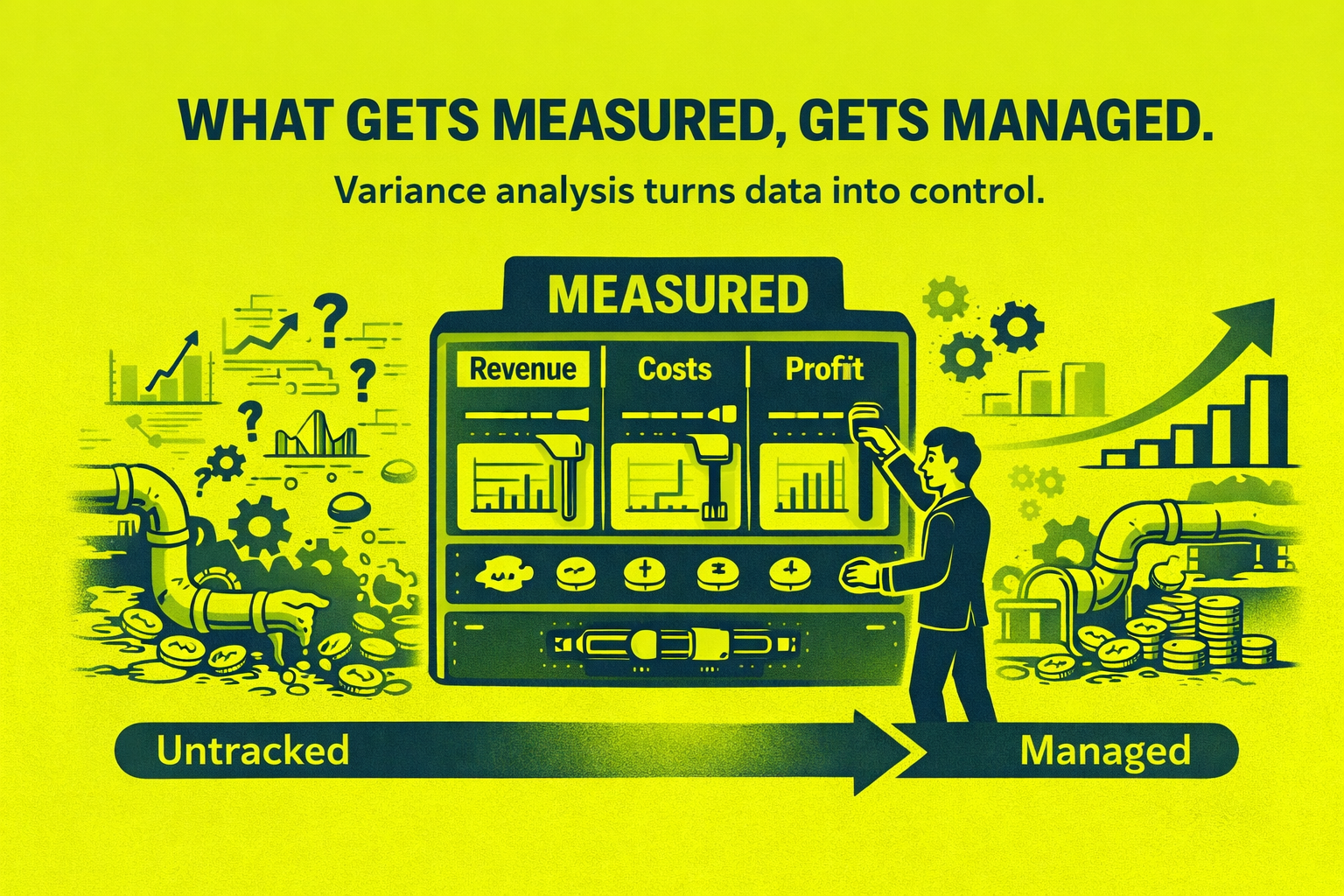
    Because the reality is simple. What gets tracked gets better. And most businesses are not tracking their performance in a way that allows them to improve it.

    No Budget, No Visibility, No Control

    A lot of companies do not skip variance analysis because they choose to. They skip it because they cannot do it.

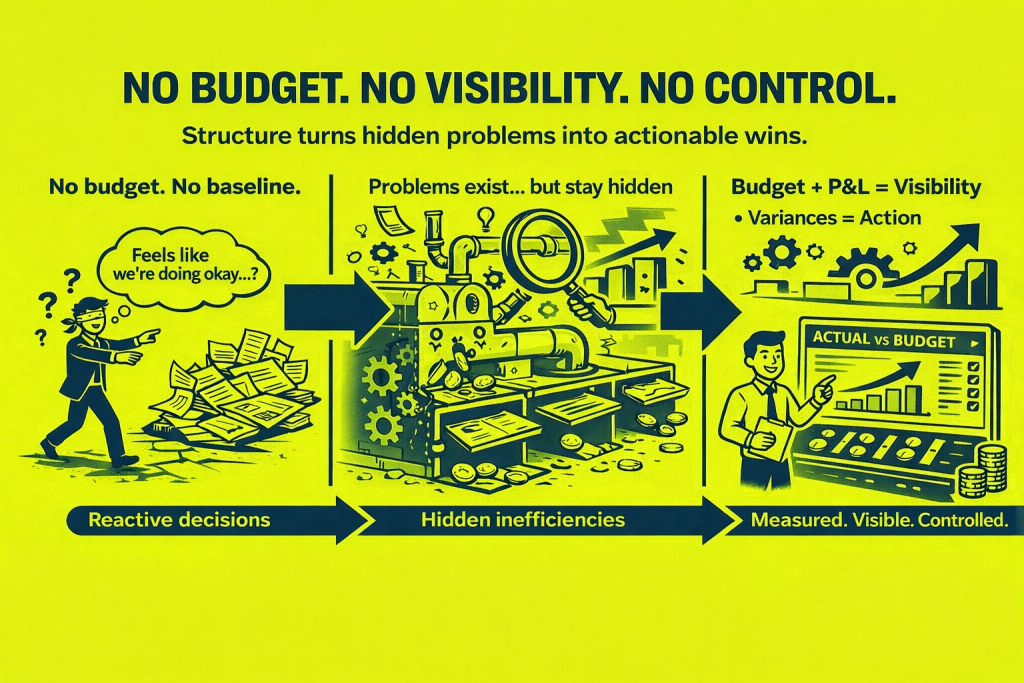
    Without a structured budget and a detailed monthly P and L, there is nothing to compare actual performance against. Finance teams are left with a general sense of how the business is performing, but no clear way to measure whether results are better or worse than expected. This creates a reactive environment where decisions are based on instinct rather than evidence.

    This is where the frustration comes in. Especially in growing businesses, there are always low hanging opportunities to improve performance. Redundant costs, inefficient spend and underperforming areas exist in almost every organisation. But without proper tracking and comparison, these issues remain hidden. The moment you introduce structure and start measuring variances, these quick wins become visible and actionable.

    When Growth Hides the Real Problem

    We worked with a technology services company that could not reach profitability, regardless of how much revenue it generated. From the founder’s perspective, the issue was clear. They believed the business simply was not selling enough, so the focus was on increasing ARR and bringing in more contracts.

    But the results did not improve.

    Once we introduced a proper budget and structured the P and L in a way that allowed for variance analysis, the picture changed quickly. Instead of looking at totals, we broke costs down into meaningful categories and started tracking deviations month by month. What emerged was a completely different narrative.

    There were tools and subscriptions that were either underused or not needed at all. Marketing spend and commission structures were not translating into revenue. Margins were too low to ever support a profitable model. None of this was visible before. The variance analysis acted as a magnifying glass, giving the business a level of clarity and granularity it simply did not have access to.

    Connecting Finance to Operational Reality

    Variance analysis on its own is not enough. The real value comes from linking financial movements to what is actually happening inside the business.

    In practice, most cost categories should not be analysed in isolation. Wages and salaries, for example, only become meaningful when viewed alongside time tracking data. This is what allows you to understand project profitability and how efficiently your team is being deployed. In the same way, marketing and advertising spend should feed directly into CAC, while gross and operating margins should be interpreted in the context of delivery efficiency.

    This is where finance moves beyond reporting and starts becoming operational. Instead of simply explaining movements in numbers, it explains how the business is functioning. Without this connection, variance analysis remains surface level. With it, it becomes a tool that drives real understanding and better decisions.

    From Reporting to Insight

    Creating a variance analysis today is not difficult. With modern tools and AI, most finance teams can produce reports quickly and with a high level of accuracy. The barrier is no longer technical.

    The difference lies in how the analysis is used.

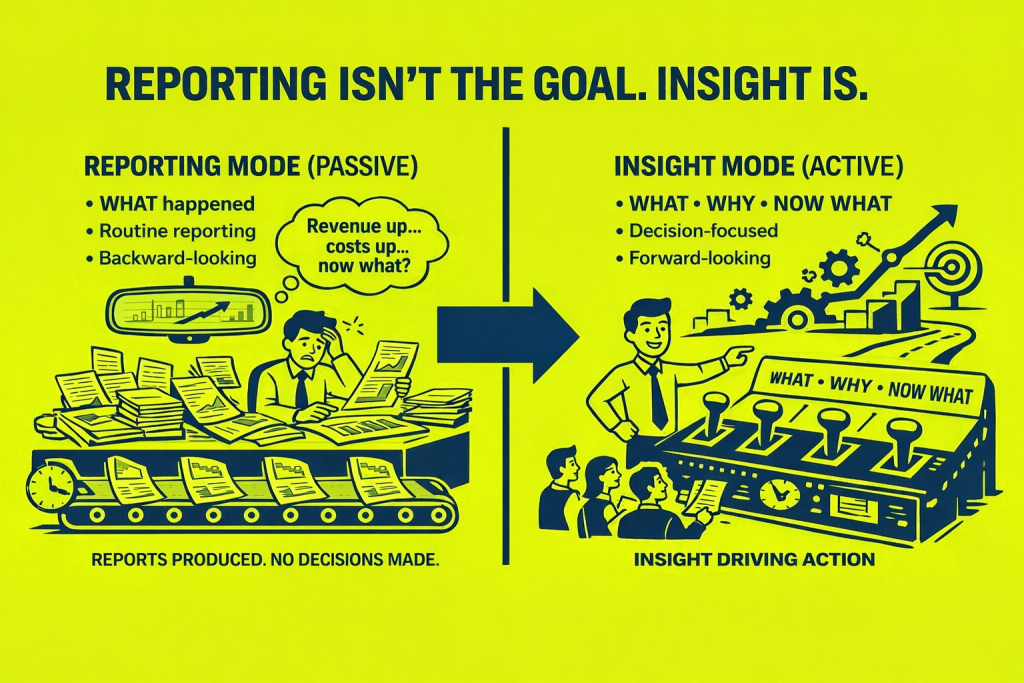
    A good variance analysis will tell you what happened. It will show that revenue is up or down, or that costs have increased against budget. But a great variance analysis goes further. It answers three critical questions. What happened, why it happened, and what that means for the business going forward.

    This is where most companies fall short. The process becomes a routine exercise, a set of numbers reviewed at month end without any real interpretation. But when done properly, variance analysis should drive a conversation. It should shape decisions, challenge assumptions and provide a clear direction on how the business needs to move to achieve its goals.

    The Biggest Mistake in Variance Analysis

    The most common issue we see is not a lack of data. It is how that data is communicated.

    Most variance analyses simply describe what happened. You will see statements like revenue is five per cent below budget or costs are slightly higher than expected. While technically correct, this does not add much value to the business.

    What is missing is the explanation.

    Why is revenue below budget. Is it due to fewer deals, lower pricing, or delays in delivery. Is the impact short term or something more structural. What does it mean for cash flow, hiring plans or growth targets. Without this layer of interpretation, the analysis does not lead anywhere.

    If there is one thing to fix in most month end processes, it is this. Add a few lines of clear commentary to every major variance. Explain the drivers and explain the implications. That small shift turns variance analysis from a reporting exercise into a decision making tool.

    Why Variance Analysis Should Sit at the Core of Finance

    When variance analysis is done properly, it changes the role of the finance function entirely.

    It shifts finance away from simply reporting historical numbers and positions it as a driver of decisions. Instead of looking backwards, the focus moves towards understanding what the numbers mean and how the business should respond. This creates a much stronger link between finance and the rest of the organisation, as insights start to influence actions across teams.

    It also introduces a level of accountability that is often missing. When variances are clearly explained and connected to operational drivers, it becomes easier to identify where performance is strong and where it needs attention. Over time, this improves forecasting, highlights risks earlier and allows the business to act with more confidence. Finance stops being a passive function and becomes an active part of how the business moves forward.

    If your month end process currently stops at reporting, there is a clear opportunity to get more out of your numbers. At Quantro, we work with businesses to implement structured variance analysis that goes beyond the surface, uncovering inefficiencies, improving margins and turning finance into a true decision making function. You can book a call with us to see how this would look in your business.

  • Pricing Is a Finance Decision, Not a Sales One

    Pricing Is a Finance Decision, Not a Sales One

    Most Pricing Advice Is Written for the Wrong Function

    Most pricing advice founders read is written for marketers. It talks about positioning, tiers, anchoring and willingness to pay. It cites the statistic about a one per cent price increase producing an eleven per cent lift in operating profit, then points to value-based pricing as the answer. The advice is not wrong. It is just incomplete. It treats pricing as a problem that sits at the edge of the business, close to the sales conversation, and largely disconnected from the operational reality behind it.

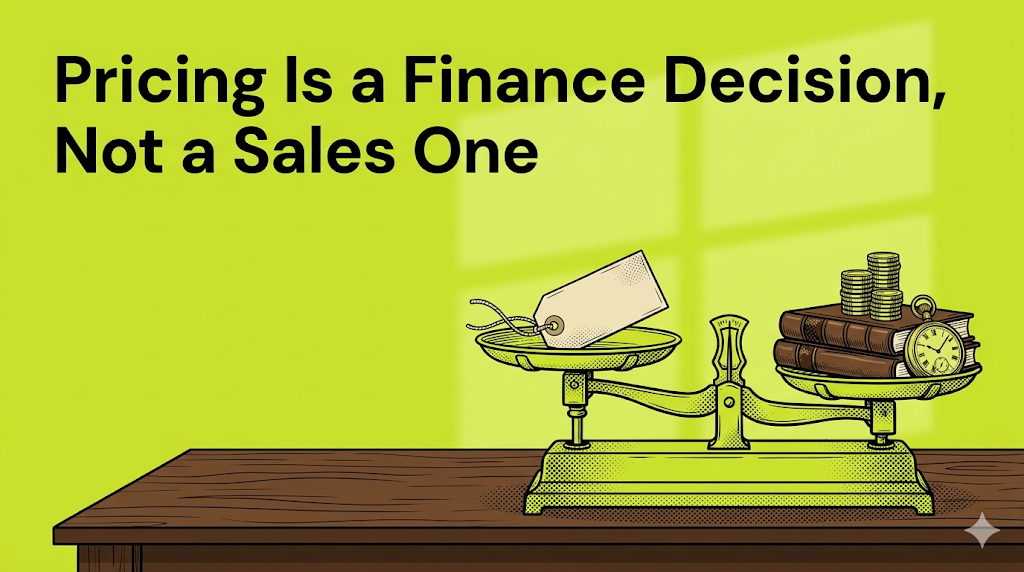
    But pricing does not fail on the proposal page. It fails much earlier, inside the numbers. By the time a founder is debating whether to charge three tiers or two, or whether to move from hourly to retainer, the decision has already been made somewhere else. It was made in the cost allocation, in the capacity data, in the margin per engagement that nobody was tracking. Pricing is not a go-to-market decision. It is a finance decision, and the businesses that treat it that way are the ones that stop negotiating from fear.

    Why Founders Underprice Without Knowing It

    Most underpricing is not a confidence problem. It is a visibility problem. Founders rarely wake up one morning and decide to charge too little. They arrive there gradually, one proposal at a time, by anchoring to the wrong references. They look at what a competitor charges, at what felt defensible in an early sales call, or at what the first few clients were willing to accept. Over time, those anchors harden into the company’s pricing structure, and nobody goes back to ask whether any of them were ever economically sound.
    The deeper issue is that most founders cannot actually see the cost of their own work. They know what revenue came in and what went out of the bank account, but they do not know what it truly costs to deliver a single engagement. Without that view, there is no way to know what a rational price even looks like. Pricing becomes a feel, not a calculation, and feel tends to sit well below what the economics require. Founders are not being generous. They are simply working with incomplete information and defending a price that was never really measured in the first place.

    The Agency That Was Charging a Third of What It Could

    We worked with a marketing agency that had underpriced its services from day one. Revenue was coming in, the team was delivering, and the founders assumed the business was on the right track. There was no obvious problem to point to. Just a quiet sense that the harder they worked, the less room the business seemed to have. That is usually the first signal that pricing, not demand, is the real constraint.
    When we applied our operational metrics, the gap became impossible to ignore. The agency could comfortably have charged 1.5x to 3x its current rates with a more deliberate approach to targeting and positioning. The founders had never seen the gap quantified before. They had built their pricing on the references available to them at the time, and those references had never been challenged. What changed the conversation was not a new pricing model. It was visibility. Once ARR per head, personnel cost ratio, average retainer and gross profit margin were placed next to industry benchmarks, the underpricing was no longer a feeling. It was a number, and that number made the decision for them.

    When a Hot Market Becomes an Excuse

    The most common pushback we hear when we tell a founder their prices are too low is some version of the same sentence. We operate in a hot market. We have to stay competitive with the guy next door. On the surface, it sounds like a reasonable commercial instinct. In practice, it is usually the argument that keeps a business stuck. If you compete on price alone, someone will always be more desperate than you. There is no floor to that race, and the winner is whoever is most willing to erode their own margin.
    The founders who price well are not the cheapest in their market. They are the ones who know exactly what they do, how they are different from the agency next door, and what their own unit economics actually require them to charge. Without that clarity, price becomes the only lever left, and it is the weakest one. Competing on price is a signal that the business has not yet built a stronger one. Once the positioning and the economics are clear, the pressure to match a competitor quietly disappears, because the comparison was never the right one in the first place.

    What Actually Breaks When You Skip the Foundations

    Every pricing article published in the last two years ends with the same conclusion. Move to value-based pricing. It is framed as a switch that founders simply need to flip, as if the only thing standing between a services business and higher margins is the decision to change the model. In reality, value-based pricing only works when the foundations are already in place. Without them, it collapses at the first client conversation, because the founder cannot defend a price they have not properly measured.
    The foundations are not complicated, but they are non-negotiable. Founders need to know their unit economics, their revenue per head, their personnel cost ratio and how those numbers sit against industry benchmarks. This matters even more for agencies, who can now operate from anywhere in the world and therefore compete against anyone in the world. Geography used to set a kind of floor on pricing. It no longer does. Economics does. A London agency is no longer priced against other London agencies. It is priced against every agency with a laptop and a similar capability set, and the only way to hold a position in that environment is to understand, precisely, what the work requires the business to charge.

    The Four Numbers That Tell You Everything

    When we start working with an agency or services business, we do not begin with a pricing workshop. We begin with four numbers. Average retainer tells us the true value of a typical client relationship, not the headline revenue figure. ARR per head tells us whether the business is genuinely productive at its current pricing, or whether the team is simply absorbing the cost of underpriced work. Personnel cost ratio shows how much of every pound earned is consumed by delivery, which is the clearest indicator of whether the pricing model is sustainable. Gross profit margin shows the real headroom left after the cost to serve, and therefore the room the business actually has to grow.

    Placed against industry benchmarks, these four numbers almost always surface the real problem within minutes. We rarely need to run deeper analysis to know whether a business is underpriced. The signal is in the ratios. A personnel cost ratio that drifts above benchmark, an ARR per head that sits below it, an average retainer that has not moved in two years while costs have, a gross margin that cannot support reinvestment. Any one of these on its own is a conversation. Two or more together is a structural issue, and it is almost always a pricing issue, not a sales one.

    The Hardest Part Is Not the Price. It Is the Client List.

    Raising prices is a constant conversation with our clients at Quantro. The difficult part is rarely the new number. Setting a defensible price, once the economics are clear, is the straightforward half of the work. The hard part is deciding what to do with the clients who were there from day one, often at rates that no longer make any commercial sense. Founders carry a real loyalty to those relationships, and the prospect of losing them in pursuit of better economics can feel like a step backwards, even when the numbers say otherwise.

    The fear is always the same. Revenue will dip in the short term, and the business will feel the gap. Sometimes it does. But the opportunity cost of keeping a loss-making client is almost always larger than the revenue they generate, because every hour spent servicing underpriced work is an hour that cannot be spent on better work. The more interesting pattern is what actually happens when founders have the conversation. The majority of clients do not leave. If they genuinely believe in the value they are receiving, they are willing to pay more. Founders consistently overestimate the resistance and underestimate how much their best clients already understand about what the work is worth.

    Pricing Is Downstream of Economics

    Once a founder has the right numbers in front of them, the tone of every pricing conversation changes. The discussion stops being about what the market will accept and becomes about what the work actually requires the business to charge. That is a very different starting point. It removes the emotional weight from the decision, because the price is no longer a personal bet on the founder’s worth. It is the output of a calculation that anyone in the business can follow.

    This is the shift that matters. Pricing sits downstream of economics, not upstream of it. When the unit economics are clear, the price defends itself. Founders stop discounting to close. They stop matching the agency next door. They stop negotiating from fear, because the number has a foundation underneath it that pushback cannot easily move. The price becomes an expression of the business, not a guess at what the client will tolerate, and the whole commercial conversation becomes calmer as a result.

    A Practical Next Step

    If pricing feels like a recurring source of tension in the business, the problem is rarely the number itself. It is that the numbers underneath it have never been measured properly. Without a clear view of unit economics, cost to serve and capacity, every pricing decision becomes a guess dressed up as a strategy. The founders who move past this are not the ones with better sales skills. They are the ones who stopped treating pricing as a marketing question and started treating it as a finance one.

    At Quantro, we help founders build the economic foundations that every pricing decision should sit on. Unit economics, the four operational ratios, industry benchmarks and the client-level view that turns pricing from a feeling into a defensible position. If any of this sounds familiar, you can book a call with us to see how it would look inside your own business. The right price is not the one the market allows. It is the one your economics demand.